

A couple of weeks ago I blogged about my plans to take on another book project, despite having no real desire to take on another book project. The idea more or less slithered into my brain when my regular work assignments recently slowed to a crawl, leaving me with a lot of extra time on my hands.
To fill in that time, I decided to take a few baby steps toward writing another book. I’d been down this road before, so it wasn’t necessarily a giant leap, and I knew there was a chance I could pull it off.
I took the same steps about a decade ago, after I was downsized from a newspaper job and similarly found myself with time to kill. I shuffled my feet and shuffled my feet some more, but eventually completed a short story collection and a novel that can be purchased here and here.
I enjoyed writing those books (mostly). But they sucked up a lot of time and energy, and did almost nothing to fatten my bank account.
I swore I’d never write another book unless it had a decent chance of earning some real money, which basically means being picked up by a legitimate publisher or agent. No more following the creative muse for the sheer joy of creating. I’d done that, was proud enough of the results, and have no regrets. But twice was enough.
Which is why…
….for this latest project, I immediately got busy doing the very thing writers are not supposed to do: I consulted AI (eek!).
But before you go judging, hear me out.
*****
The main reason I consulted AI is because I wanted to get advice on how to maximize the commercial potential of the book I had in mind. Artificial intelligence might eventually be the doom of us all, but for now, it’s still a pretty good place to get data aggregated from thousands of different sources.
My idea is to document how I left my old life behind at age 40 and embarked on a new adventure in new places, all on the off-chance that I might finally fulfill the dreams and ambitions I’d spent the previous decades falling well short of.
My life change happened more than a quarter-century ago. In the years since, I’ve ticked off a whole laundry list of goals I long held dear but wasn’t sure I’d ever get around to fulfilling. If I hadn’t risked so much at the age of 40, I never would have lived the very blessed life I have now.
I figured my experience would make for a book that some people might want to read – how to reset your life in the middle and fulfill dreams that long seemed just out of reach.
But I didn’t want to sit down at the laptop and just wing it. I needed some kind of structure to make sure I was on the right track. So, I consulted AI for info on everything from how to construct such a book to which publishers and agents might be interested – and how to pitch them.
That’s when I took a very deep dive down the AI rabbit hole.
The more info I requested, the more info AI suggested. I got loads and loads (and loads) of data about market demographics, target readers, likely publishers and agents, competing titles, how to structure such a book, how to write it, how many chapters it should have, a sample table of contents, sample chapters, sample marketing pitches, various esoterica concerning themes and narratives. And on and on and on.
I copied and pasted all this data and tossed it into a Word file. At last count, that file is 58 pages long.
*****
Granted, there was a lot of useful information about how to ensure my book has the best chance of securing a publisher and reaching its intended audience.
But it was also a little mind-melting, the thought of sifting through these endless reams of data and advice. I wasn’t exactly sure how to proceed. Paralysis set in. I couldn’t bear the thought of weeding through it.
I basically did jackshit during the first couple of weeks. I’d peek into the file, highlight a couple things, then scramble out to do anything else in the world.
I got a trickle of free-lance writing assignments that occupied part of my time. And there were some personal finances to go over. And home chores. And errands.
Plus, I had some magazine reading to catch up on.
Plus, I had some book reading to catch up on.
Plus, there was tennis to watch, and baseball, and basketball. And streaming shows.
I looked at cooking videos (when you’re the home chef, there are never too many cooking videos).
I doomscrolled through a soul-killing battlefield of news and political sites.
I listened to music.
I went over my finances.
Did I mention I had some tennis to watch? Is it any wonder I put off starting the process of writing another book? Who has the time?
Well, okay: I had the time. I just didn’t make the time. What I mainly did was anything and everything in the world that would keep me from writing a new book. Because I really, really didn’t want to write a new book.
But then a miracle happened, just a couple nights ago.
I sat at the laptop and just started typing. I put my fingers on the laptop and hit some keys. One, then the next. One, and another. One after the other. The fingers did the work. I wrote a sentence. Then a paragraph.
This is the way of writers. You start with a word, then a sentence, then a paragraph.
Admittedly, AI played a key role. I looked through the 58-page Word document to find a good starting point. I found a section on how to write a book introduction, based on all the data I fed into AI (in this case, Google Gemini. I have recently soured on Open AI, for reasons both personal and political).
Gemini provided a framework of an introduction. I followed its lead, fairly closely. After a few paragraphs tumbled out, I fed my text into one of those AI detectors that let you know how much of what you wrote originated with artificial intelligence. After my first draft, I was told that about 75% was AI-generated.
Well, that wouldn’t do, now would it?
So I tossed out that draft, and just followed my own muse. I took a couple of the AI ideas and fleshed them out according to my own inner map. Soon enough the beginnings of an introduction matriculated.
What follows below is what I wrote. For what it’s worth, it scores nearly 100% on the original content, non-AI scorecard. It’s a first draft, so maybe a little raw. I’ll share it here simply because it soothes my soul to do so. I will publish it in its virgin form, with no further edits. It’s intended to be a road map rather than a memoir, so it will lean heavily toward actionable life steps rather than literary magic.
I probably won’t share much more of the book beyond this. I have some ideas on how to proceed from here, but those will remain with me and I only.
If you are so inclined, let me know what you think…..
*****
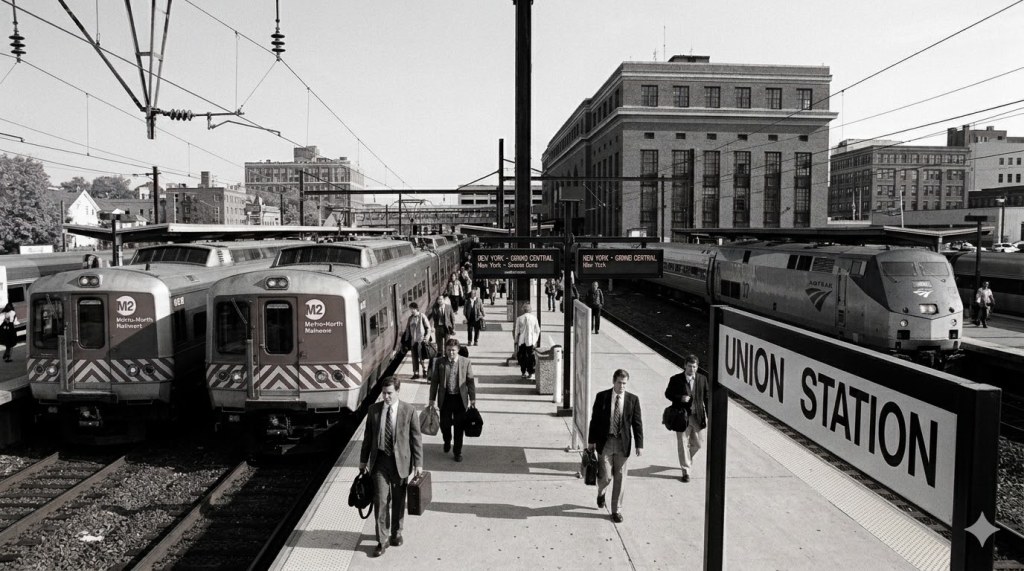
I can’t remember exactly what time I woke up for that first, magical train ride into New York City, but you can bet it was early. I had to be at the office before 9 a.m. The first leg of the journey was a 20-minute drive from my temporary home in Wallingford, Connecticut, to Union Station in New Haven. After that, I had to catch the Metro North commuter train to Grand Central Terminal in Manhattan – a 90-minute haul, followed by a 10-minute walk to the office. I caught one of the earlier departures and planted myself onto a worn vinyl seat among a bunch of stone-faced folks who stared at their newspapers, work files, or nothing at all.
It was March of 2000, my first day on the job at a newspaper in midtown Manhattan. I was 41-years-old, and stupidly excited for a guy my age. Breakfast consisted of a homemade bagel and coffee I scarfed down early on in the train ride. The Dave Brubeck Quartet’s “Time Out” played through the headphones of my low-tech Sony Walkman cassette player – an album famously composed in unusual time signatures.
Outside, the scenery shifted from wealthy coastal villages to the gray and jagged skyline of the Bronx and then into the dark tunnel below Manhattan, reminding me that my own life was moving in a pretty unusual time signature as well.
A year earlier, I was employed with a different newspaper, hundreds of miles away in my hometown of Charlotte, North Carolina. I had spent 33 of my first 40 years living in and around Charlotte (college took me away for five of those years, but not very far away). I had never lived outside of the American South – no matter how many times I tried to convince myself that one day, someday, I’d live a life of global adventure.
In fact, my life at that point was mostly spent circling around the same series of dead-end jobs, failed relationships, crappy apartments, and questionable financial decisions. I was staring into the approximate midpoint of a life that seemed on the fast track to incurable disappointment and underachievement.
I’m sure I reviewed all this in my head that first day traveling the fast track from New Haven to Grand Central.
By most societal standards, I was what can generously be labeled as “behind” in life. I was 41 years old and finally embarking on a dream I’d had for decades – working as a journalist/writer in New York City.
Up until that point, my level of accomplishment could be measured in millimeters. I had never lived very far away from my Charlotte comfort zone. I’d never traveled outside of the United States. I’d never owned a home, never married, never had kids. According to the invisible clock we all carry around, I was supposed to be settling in, not starting over.
It wasn’t until later – long after I’d taken one final shot at chasing a dream before it faded from view – that I realized the invisible clock is a lie. It doesn’t exist. If you hear it ticking, ignore it. I don’t care how old you are or think you are: Ignore that clock. Because it’s a lie.
My life today is proof enough.
Twenty-six years after taking that first commuter ride on the Metro North, I’ve stitched together a reasonably successful career that has led to financial security, two homes in two different cities, no real debt to speak of, and just enough wealth to carry me comfortably through my golden years. I’m married, with two children. I’ve lived in New York City, Los Angeles and London. I’ve written books, traveled around Europe and parts of Africa and Latin America, and checked off more life boxes than I dared imagine possible as a 40-year old stuck in an endless loop of failed expectations.
This book is for anyone who has ever looked at their life at 35, 45, 55 or beyond and felt the creeping dread that it’s “too late” – too late to pursue that career you’ve always cherished, too late to follow your passion, too late to relocate halfway around the world, fall in love, start a family, launch a business, write a book, paint landscapes, learn a new trade, shift gears, grow, learn, change, dream.
This is for anyone who finds themselves frozen on the platform, wondering whether they should hop on the train or turn back around. Take it from me: Hop on the train. I’ll even share a few tips on what to do once you’re aboard. Don’t worry about the coffee or bagel. Just hop on the train.
It’s departing sooner than you think, and the next one might not come around for a while.
About the image: It’s an AI creation (that again) of what New Haven’s train station looked like in the Year 2000.
 Vance Cariaga
Great opening. It really sets up the expectation of what the reader will get from the book, hints at the adventures ahead, and establishes who the target audience is – all nicely wrapped up within that opening story. I really look forward to seeing where this goes 🙂
And well done on pushing through the many levels of procrastination to actually get started! I think for a lot of us, that is the biggest struggle. And once we actually have something down, and force ourselves to make an effort, the momentum comes and we tap into the natural penchant we have for releasing what we need to in writing.
You also brought up something worrying about these days: the thought of an AI detector running through my work and spitting out a false verdict scares me. But using it for the planning and conceptual work, as you’ve done, is a smart way to go about things. In the past, I imagine you’d go to an agent, editor, or consultant for that type of guidance, so it’s great that you have that more easily accessible.
Again, well done, and I hope you’ll stick with this regardless of the fluctuations of incoming work. We all have wisdoms and valuable insights to share from our life stories, and you definitely have both the experience and ability to translate yours into something that many people will enjoy reading.
LikeLike