

Here is another in an occasional series of tennis nerd blogs. Fair warning, for you non-tennis fans…..
Last week one of my all-time favorite tennis players retired as a professional, closing out a fine 17-year ATP career. Chances are you didn’t know this – and maybe have never heard of him – unless you happen to follow tennis. His retirement came about a year after Roger Federer retired – something you probably did know about, whether you follow tennis or not, because Fed was a tennis God, or maybe just a God, period.
This blog is not necessarily about tennis – or maybe it is, but not exclusively. It is mainly about how we define success. More on that later.
The player who retired last week is American John Isner. His career ended after losing in the second round of the U.S. Open in a five-set heartbreaker to fellow American Michael Mmoh. I saw Isner’s final two matches on TV – a first-round win over Argentina’s Facundo Diaz Acosta, and the round two loss to Mmoh – because I was able to set up my smart TV like the tech genius I am (see my last blog for details) and see the U.S. Open action.
Isner, 38, began his pro tennis career in 2007 after playing collegiately at the University of Georgia. He is and will forever be best known as the winning player in the longest pro tennis match ever played (or at least the longest on record): an impossibly grueling five-set win over Frenchman Nicholas Mahut in the first round of the 2010 Wimbledon Championships that lasted more than 11 hours and took place over three days.
The final score was 6-4, 3-6, 6-7, 7-6, 70-68. You read that right. The final set score was 70-68 – 138 games in a single set. That’s more games than you are likely to find in any three full-length five-setters. It took more than eight hours and a couple of days just to play the final set.
This was before they had a fifth-set tiebreak. In fact, this match and a subsequent 2018 Wimbledon semifinal Isner lost to South African Kevin Anderson by the score of 7-6, 6-7, 6-7, 6-4, 26-24 are among the reasons Wimbledon finally caved and adopted a fifth-set tiebreaker like all the other major tournaments.
Anyway, John Isner….
He’s a North Carolina native (from Greensboro), which is one of the reasons I adopted him as a favorite player – because I, too, am a North Carolina native. He is the greatest native North Carolina tennis player ever. I’m not sure who is No. 2. Probably John Sadri, a Charlotte native (as am I!) who in 1980 rose to No. 14 in the world. Sadri won two pro tournaments and reached the final of the 1979 Australian Open. He played tennis for a competing high school while I was in high school. That’s how old I am (sigh).
*****
John Isner announced before this year’s U.S. Open that it would be his final tournament. Up until about a year ago he was still a very competitive player. But in 2023, age and nagging injuries began to take a toll. He got married a few years ago, and he and his wife now have four young children. He decided to hang it up.
I am now going to recite some John Isner highlights off the top of my head…
- He helped the University of Georgia win the NCAA men’s championship in 2007 as a collegiate player.
- As a pro, he won 16 ATP tournaments. He reached the finals of a Masters 1000 event five times – once at Indian Wells, once in Cincinnati, twice in Miami, and once in Paris. He won the 2018 Miami final – his greatest victory as a pro.
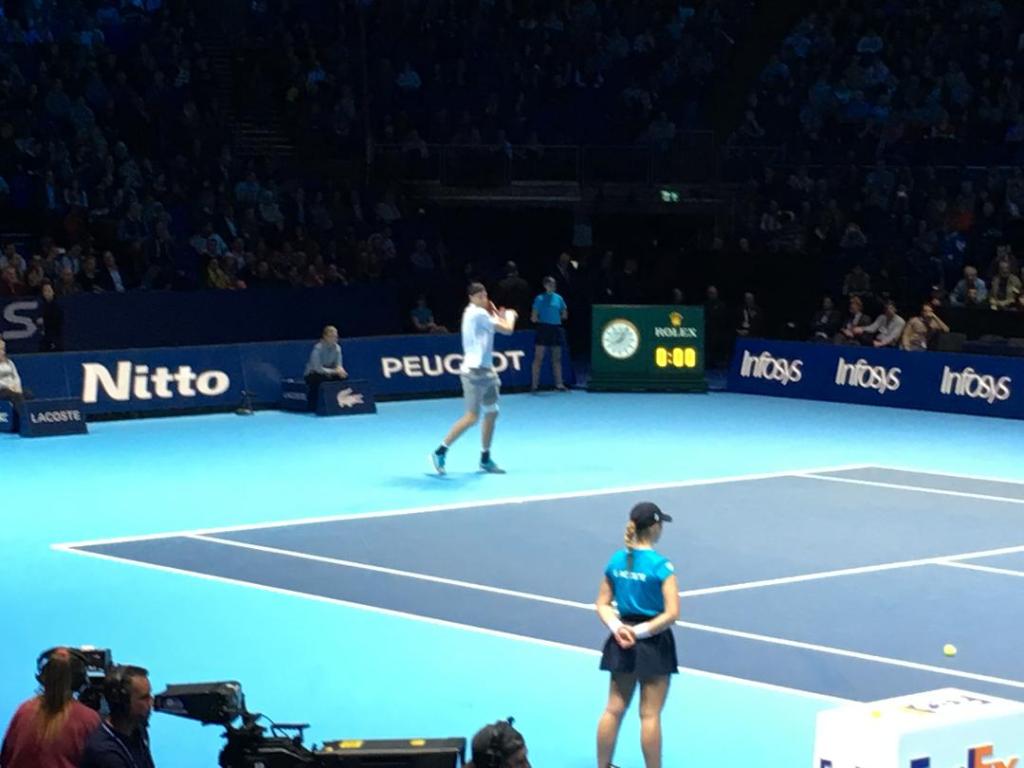
- He reached the quarterfinals of two U.S. Opens and the semifinals of Wimbledon. He was ranked a career high of world No. 8, and played in the 2018 ATP Finals in London, in which the eight best players in the world competed. The fuzzy picture accompanying this blog is one I took at that very 2018 ATP Finals while we were living in London.
Isner’s career was defined by overachievement. He’s a big man – 6 feet 10 inches tall, about 240 pounds. He had a massive serve, probably the best in men’s tennis history. He set the record for most aces in a career. But he was not the greatest mover on the court, had only a so-so backhand, was not a great returner of serve, and could not grind his way to wins the way smaller players could. Many of his matches took a huge physical toll on his body.
But: He was consistent. Amazingly consistent.
He was a top 20 player for a decade in a row. He was the top-ranked American player for a decade in a row. He made the best of his tools and always competed hard. He was underrated in some parts of his game. He had a reputation as just a big server, but he had an excellent forehand, and very soft hands at the net. He was a good doubles player because of his net/volley skills.
Most importantly, Isner was just a nice guy, very well liked and respected on the tour. He was humble and seemed amazed that his career took him as far as it did.
I was glad to see the U.S. Open pay tribute to him after his first-round match with a video recap of his career and an on-court interview. He deserved it, and got choked up over it. He carried the banner of U.S. men’s tennis in what has easily been the low point of U.S. men’s tennis in terms of results on the court.
We are all hopeful that U.S. men’s tennis will rebound to more prominence on the world stage thanks to talented young players like Taylor Fritz, Frances Tiafoe, Tommy Paul (another North Carolinian), and Ben Shelton. We’ll see how it goes.
*****
Earlier in this blog I mentioned that part of it has to do with how we define success. The reason I mentioned this is because of Isner’s career.
He was never the best in the world – not even close. He played during the era of Federer, Nadal, and Djokovic (and Murray, to a lesser extent), and the gap between those players and everyone else was as wide as the universe itself. Djokovic, who is now 143 years old, is still maybe the best player in the world (although I’m pulling hard for the young Spaniard, Carlos Alcarez).
Isner never had the skills of those players, or the athleticism. He never had the best tools in the toolbox, but he made the best of the tools he had. He was amazingly consistent. He never had an off year as a pro. He never succumbed to the mental ups and downs that plague so many players. He was level-headed and dedicated, and always right there in the mix. He worked hard, all the time, to extract the most out of his talent.
It so happened that Isner retired at the same time as countryman Jack Sock, who announced his pro tennis retirement to take a stab at the pro Pickleball circuit (never heard of Pickleball? Oh, never mind….). Isner and Sock lost a first-round doubles match as teammates, and that was that.
Sock, only 30 years old, had a much different career than Isner. Sock is a magnificent athlete, very skilled. He rose to No. 8 in the world in 2017, at only 24 years old. He made the semifinals of the ATP Finals in November of that year. He seemed destined for a long run as a top player, possibly a major champion.
Then he fell off the map. I’m not sure how many matches he won in 2018. Maybe less than 10. His ranking cratered. He fell out of the Top 100 and then the Top 200. I’m not sure he ever got back into the Top 100.
This was amazing to me – how a player who rose so high so quickly could fall so fast just as quickly. I’m not sure I’ve ever seen it in tennis before.
There were some physical issues, yes. But that wasn’t the main problem. The main problem was that Sock maybe didn’t work as hard as he could have once he had soared to the Top 10. That proved problematic when he began playing matches again. Once he started losing, it became a mental problem, a lack of confidence, and a lack of a backup plan to win matches even when you’re not at your best.
This is what separates the best players from the also rans, in any sport – the ability to solve problems and win even when you are not at or even near your best. It applies to all walks of life, beyond sports.
*****
In a former career, I was a section editor at a national business publication. There were about eight reporters in my section. Some of them were very gifted writers, but not always the best at getting stories done on time, or maintaining a keen focus throughout the work week, or putting in the best effort. Others were not the most talented – but were always consistent, always met deadlines, always worked hard and put in their best effort.
How would you define the success of one vs. the other? Would you favor the worker who could reach heights others couldn’t, but also hit lows that others avoided? Or would you go with the one you could always depend on, day in and day out, even if they didn’t reach the highest talent level?
Frankly, the world often rewards those with the highest talent level, the ones who break new barriers, even for a brief moment, before fading from view, because they don’t have the dedication and/or mental makeup to keep it going for the long haul.
When I was managing a staff, I always – always – favored the hard workers who might not have had the most natural talent but were always consistent, and always dependable.
John Isner was consistent and dependable. He never made a lot of headlines (outside of the Marathon Wimbledon Match, in which he and his opponent refused to concede defeat, even long after they would have been forgiven for doing so).
But Isner was consistent. He worked hard, made the most of his talent, was dedicated to his sport, and did himself and tennis proud. I’m sorry to see him go. But I’m glad to have been his fan, and to have seen him play in person, at least once.
 Vance Cariaga
I didn’t see that epic Wimbledon match, but read about it… though I still can’t quite believe the final set going that far.
It’s a testament to the man to have played to such an age, in a sport where 30 is considered old. (Or at least it was back when I watched… Agassi played longest from the generation I watched.)
So you never played Sadri in your high school days?
The whole thing, though, reminds me of a quote by Sir Alex Ferguson (Britain’s greatest ever football manager):
“Hard work will always overcome natural talent when natural talent does not work hard enough.”
And having managed Manchester United for 27 years, to and through the club’s greatest period of success, he knew all about the different types of people in a team.
Even on a layman level, though, I reckon if we consider those we went to school with, and look at those who got good grades but didn’t work hard, and compare them to those who struggled but worked hard, in many cases, the latter ended up more successful in their working lives as adults. It’s just a natural law that consistency and hard work usually wins out over those who can’t maintain a certain level even with the best of talent. The old story of the tortoise and the hare is another classic example of that principle.
LikeLiked by 1 person
I love that quote from Ferguson, though I had never heard it before. He’s spot on. And you’re right — hard work and consistency usually rule the day in the business and working worlds. Any good manager would prize those qualities.
Nah, I never played John Sadri. In high school I chose baseball over tennis as my school sport (they both were played during the same season), which is something I kind of regret.
But: Sadri would have wiped the floor with me, even if I had chosen to dedicate myself to tennis. I doubt I could have won a game off him. The difference between the successful pros and everyone else is as wide as the Pacific. Even in high school Sadri’s talent was probably pro level. Mine never was. 🙂 I might have been a decent small-college player if I had devoted my time to it.
That Wimbledon epic was almost painful to watch. Those guys just wore themselves down to the point that they were probably not at their physical best for the rest of the year. Isner barely had any energy for his next match, which he lost quickly.
LikeLiked by 1 person
Vance, nice to be back in the WordPress Universe again and seeing you here. I remember Isner’s multiple-day tennis match. That was nuts. I am trying to convince my wife I am still made for the tennis court opposed to a pickleball court. She can’t play tennis anymore, but perhaps in the new year she will deem it acceptable for me to resume my “career.” I think you hit an ace with the comment about Isner making the most of his talent. Spot on.
LikeLiked by 1 person
Thanks Bruce, I appreciate the feedback! More importantly…..
WHERE HAVE YOU BEEN???? I feared the worst when you disappeared after your March Madness blog. That’s the thing about digital acquaintances, when someone stops blogging or posting and you don’t really know them personally, you wonder if some horrible event has befallen them. Glad to hear you are well and back at it! I’d love to hear what you’ve been up to the last several months. We have moved back to the USA since the last you and I communicated. Let me know what’s up! I think maybe you and I have corresponded on LinkedIn as well.
LikeLiked by 1 person
Vance, I did recall your “big move” was in play while I was away. Sounds like everything (eventually) came out just fine. That’s a doozy of a move, I just stepped away from the keyboard. No event or events led up to it. I think when I wandered away to take in March Madness I just found being less “digitalized” freed up more time in the Spring (and eventually Summer) to watch/catch-up on movies, series, etc. At least I had the good sense (finally) to leave the blog behind and intact, so now I have a template of sorts to work from. Mrs. Chess and I are doing well, and I hope your family is also!
LikeLiked by 1 person
Sounds like a refreshing step-away, Bruce. Something we all should do from time to time.
LikeLiked by 1 person