

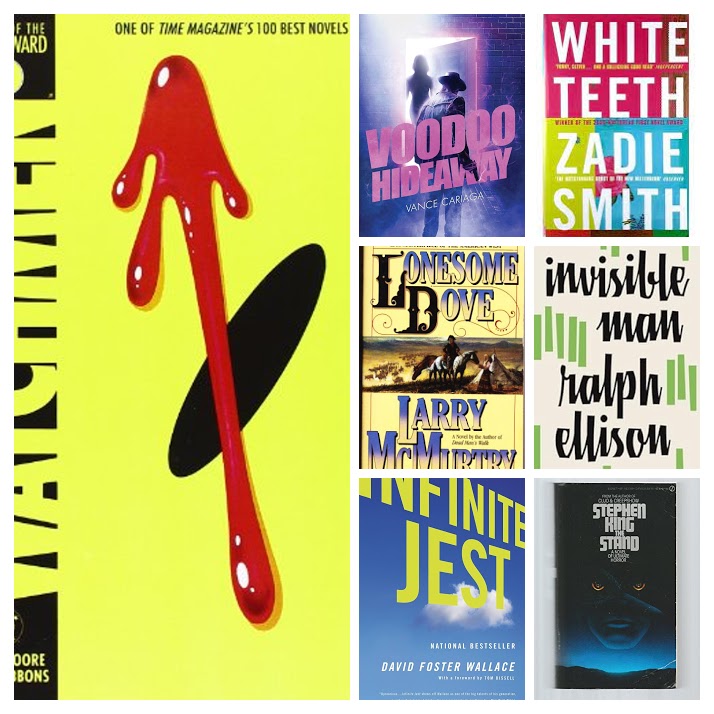
There are two big fat books in my reading queue that I plan to get to when I’m done with the current novel I’m reading. It’s nice to see those heavy tomes sitting there, waiting to be cracked open and read. With fall upon us and winter lying in wait, it is now the time of year for long books. They’ll probably take weeks or months to finish. That’s the beauty of it – I now have weeks or months to finish them, all holed up and hibernated.
This doesn’t happen over summer, not with family vacations and whatnot. Summer is for short, breezy novels you download on your Kindle when you’re out of town and knock off without really paying attention. Fall and winter are for deep dives into complex stories with epic story arcs and rich characters you come to love or hate, or both.
One of the books in my queue is “Gone With The Wind” by Margaret Mitchell. My copy clocks in at just shy of 700 pages. There was a time when “Gone With The Wind” was the most famous novel in the United States, if not the world. The buzz surrounding its publication in 1936 was something that is rarely seen today. I’ve seen the movie a few times, but never read the novel.
It must be said: The movie, released in 1939, was a cinematic masterpiece that broke new ground in terms of its look, scope and length, but today is more than a little complicated. It gobbled up a bunch of awards, had some of the most breathtaking camera shots in movie history, and became a beloved classic for decades – at least for some folks
But in 2024? Well, put it this way: It hasn’t aged well. GWTW’s depiction of happy slaves and noble Confederate soldiers in the Antebellum South could not be more cringeworthy, off-key and historically inaccurate.
With that said, I look forward to finally reading the novel. I’m not usually a big fan of sprawling historical epics, but since I know the Hollywood version of the story and characters, I at least will go in with some familiarity.
The other long book in my queue is “The Stand” by Stephen King, the apocalyptic 1970s classic. This, I have read before – at least twice, and maybe three times. I have no problem re-reading books. I’ve done it plenty of times with plenty of books. But there’s a twist this time – I am going back to the original version of “The Stand” published in 1978 rather than the longer, revised version King himself approved for publication in 1990.
I’ve read both versions, and like the original better. Don’t ask me why. It seemed to be a tighter, more compelling read, even at about 800 pages (the revised version is closer to 1,200 pages). I remember loving the original version. I don’t remember loving the revised version – and I want to go back to loving “The Stand” again. I look forward to revisiting it.
*****
As part of my occasional dive into book blogs, this one is devoted to long books I have enjoyed and recommend. The list is surprisingly short – only eight books, plus a special bonus book at no extra charge. What this tells me is that I haven’t read that many long novels. Maybe they scare me off. Or maybe I’m just too lazy. Or maybe I need to branch out more. Probably some combination of the three.
I have read and mostly loved the following books. In some of the descriptions below, I’m borrowing what I previously wrote about them. The page counts for each book are included, most of which come straight from books on my shelf. My guideline is that a book must be at least 500 pages to qualify as “long,” though I have made a couple exceptions to that rule. Keep in mind that page counts will vary by publication date, print type and book form.
Feel free to let me know what long novels you like (I’m always looking for new titles).
Infinite Jest, David Foster Wallace (1,070 pages): This is the mother of all long novels, and if someone asked me what it’s about, I probably couldn’t tell them. Published in 1996 to great fanfare, “Infinite Jest” loosely tells the story of a future world involving a group of Québécois radicals, Boston drug fiends, a tennis academy, and the family that runs it. The individual narratives – and there are a lot of them – are connected by a film titled Infinite Jest, also called “The Entertainment.” It’s not an easy book to read, and it can obsess over the tiniest little things. But it’s brilliant in many different ways – not least because its author, a fascinating guy who met a tragic end, was simply a genius at the written word. I once read an interview with him where he said that “Infinite Jest” is a circular story intended to be read and then re-read immediately. That’s a fascinating concept, but I’m not sure I’ll ever read it back-to-back. But never say never…
The Stand, Stephen King (820 pages): A deadly strain of influenza has killed off nearly all of the world’s population, leaving the survivors in a standoff between the forces of good led by an elderly woman in Nebraska and the forces of evil led by a “dark man” in Las Vegas. Sides are picked, a showdown is coming, and the intrigue is addictive. This is King’s masterpiece, and it still resonates today nearly 50 years later. Extra points for lifting a lyric from Bruce Springsteen’s 9.5-minute rock classic, “Jungleland.”
The Nix, Nathan Hill (680 pages): I read this book in 2018, was left dumbfounded over how good it was, and immediately posted about it on Facebook because I wanted to share my reaction with the world. Here is part of that FB post:
The story itself is interesting enough. It follows Samuel, a 30-something literature professor and failed writer in the Midwest whose mother abandoned him when he was a kid without ever telling him why. The first chapter actually begins with Samuel’s mother at a political rally in 2011, where she hurls gravel at a presidential candidate and gets in deep caca over it. The “nix” itself is the name given to a Norwegian spirit whose basic message is: “The things you loved the most will one day hurt you the worst.”
The plot shifts between Samuel’s story, his mother’s story, and the stories of certain secondary characters connected to Samuel or his mom: a troubled childhood friend, a childhood crush Samuel loved from a distance all the way into adulthood, one of his college students, one of his fellow online gaming geeks, his grandfather, his publisher, a rogue cop-turned-judge, a jaded ‘60s feminist. You bounce around between 2011, 1988 and 1968, between Norway and the ’68 Chicago Democratic Convention, between hippies and web addicts and con artists and factory workers and sexual deviants and vengeful judges and Occupy Wall Street protesters and Walter Cronkite and Allen Ginsberg and Hubert Humphrey (who is hilariously bizarre here).
There were times when I just sat there gape-mouthed, damn near out of breath, at how ingeniously Hill turned phrases and put words together – at how spot-on his characters were, how imaginatively his scenes were laid out, how alternately poignant and hilarious his passages could be. I erupted with laughter on more than one occasion.
I’ve never seen anyone sustain such excellence through so many pages. Almost every paragraph spins your head around. Nathan Hill has been compared to John Irving and Dickens and David Foster Wallace. I don’t like those comparisons. To me, the guy is a planet of his own.
White Teeth, Zadie Smith (540 pages): Another instant favorite, this one by a British author. Here is part of the blog I wrote about it in 2020:
“White Teeth” is one of the best books I’ve read in a long time. It has the richest characters, the funniest lines, the best dialogue, the most engaging scenes. Let’s talk about her characters. They all live in London during the latter half of the 20th Century, with flashbacks dating to World War II, the 1970s, the 80s, the 90s.
There’s a working class Muslim Bengali family whose parents are the product of an arranged marriage. They have one twin son who is a star student and good lad, and has been sent back to Bengal to live a pure life, away from the secular temptations of white-ruled London. The other twin son, a more reckless lad, stays in London and spends much of his time getting into trouble, getting high and getting laid. Dad is much older than Mom, and they fight constantly, both verbally and physically. The sons make bets over who will win.
There’s another working class family with an English Dad, his much younger Jamaican wife, and their mixed-race daughter (maybe based on Zadie herself). The Dad is a simple sort who wants nothing much more than a pint at the pub. Mum grew up in a devout Christian Jamaican family, and her own Mum doesn’t much like her marrying a white man.
There’s a middle-class white liberal family full of achievers who are not given to false modesty, are very impressed with their own bloodlines, but take a keen and not altogether disingenuous interest in more troubled folks with darker skin.
The novel is a multi-ethnic stew of different races, classes, religions, ages, sexual preferences and education levels. Zadie Smith writes these characters expertly, as if she inhabits them all. She is spot-on in the way they talk, the way they move, the way they think, the way they mix in the company of others. There is not a single one that is not fully realized and instantly believable.
Lonesome Dove, Larry McMurtry (950 pages): I carried this book along with me on a trip my wife and I took to Paris in 2005, as a kind of second honeymoon a year after we were married. We were living in New York City at the time. So it was quite a juxtaposition, reading a classic American western in New York and Paris. Published in 1985, “Lonesome Dove” is set in the latter days of the Old West and follows a group of retired Texas Rangers who are driving a cattle herd from Texas to Montana. There are some deep themes at play here, but the story is entertaining, and the writing keeps you engaged all the way through.
Watchmen, Alan Moore (350 pages): This is a graphic novel that combines comics and prose passages. Although it’s “only” 350 pages, that’s long by comic book standards. This is probably the greatest graphic novel ever, and if it’s not, you’ll have to prove it. It has been so widely praised that many book reviewers consider it as much a work of literature as a comics series. The book, published as part of a 1980s series, serves as both a satire of superhero concepts and a scathing indictment of Reagan/Thatcher-era politics.
Invisible Man, Ralph Ellison (580 pages): From an earlier blog:
Not to be confused with the H.G. Wells sci-fi classic of the same name, this “Invisible Man” details what it’s like to be an African American in the middle of the 20th century, which is to be invisible to a large segment of society. That probably hasn’t changed much in the 60-odd years since this book was published, but that’s another tale for another day. The book follows the tale of the narrator, an unnamed black man, as he goes from a promising student at an all-black college in the South to a kind of half-serious militant in Harlem. This could have been one of those heavy handed, socially conscious yawners they make you read in Sociology class in college. Instead, it’s very entertaining, often hilarious, and filled with great dialogue, memorable characters who strike the perfect note, and gripping scenes that leave you wanting more.
Don Quixote, Cervantes (980 pages): From another blog:
“Don Quixote” continued my dive into classic literature over the past several years, and this one often tops lists of greatest novels ever. Do I agree? No, not really. But I will say this – it is often a damn good read, much better to my tastes than all the other big fat classic lit novels I’ve read over the past few years (I’m talking to you Moby Dick, Great Expectations, and Crime and Punishment….).
“Don Quixote” follows the adventures of the title character, a clueless and potentially batshit would-be knight errant, and his long-suffering sidekick, Sancho Panza. It is often hilarious, sometimes poignant, doesn’t seem to take itself too seriously, and has some Very Important Things to say about class divisions, history, and relationships. I particularly love the Sancho character. He’s memorable in more ways than I can explain here, but mostly because he’s just a poor peasant caught up in something he didn’t figure on, but remained wise, noble, patient, and hilarious to the end.
Is the book too long? Yes, it is. F**k yes, it is! Cervantes could have shaved it in half without losing a thing. The literati will hate me for saying that, but screw ‘em. Still: It can be very entertaining. If you are going to read a 980-word literary classic, this is the one.
Voodoo Hideaway, Vance Cariaga (360 pages): Okay, I wrote this 2021 novel and it comes in at a crisp and un-put-downable 360 pages. What’s the point of having a blog if you can’t pimp your work? You can buy it here and here and here.
*****
As long as we’re on the subject of long books, here are some other scattered thoughts….
Waiting To Be Read
Gone With the Wind, Margaret Mitchell (690 words)
Tried But Failed
I tried more than once to push my way through these books, but fell short every time. Maybe someday…
Gravity’s Rainbow, Thomas Pynchon (760 pages)
One Hundred Years of Solitude, Gabriel Garcia Marquez (510 pages)
Never Again
I read these books as part of a commitment I made several years ago to read more literary classics. I made it through both of them. And I will never read them again, either because they simply didn’t connect with my 21st century self, or they bored the crap out of me, or both.
Moby Dick, Herman Melville (660 pages)
Crime and Punishment, Fyodor Dostoevsky (510 pages)
 Vance Cariaga
Interesting list. I read– and liked– Crime and Punishment, but I’ve heard that Infinite Jest ( along with Gravity’s Rainbow) is nearly impossible to finish or comprehend.
For another longish book you might consider The Wind Up Bird Chronicle by Murakami
LikeLiked by 1 person
Thanks for the Murakami rec, Matthew, I will put it on the list. I have read and enjoyed a couple of his other books. I’m probably in the minority on “Crime and Punishment.” I also read “The Idiot” and that didn’t seem to take either. And yeah — “Infinite Jest” is not an easy read at all. But there’s some great stuff in there writing wise.
LikeLiked by 1 person
“Arcadia” by Iain Pears is one I read last year. It’s a sort of fantasy time-travel type thing which I’d recommend.
“Babel” by RF Kuang was another, which moves slowly for a long time, but is a slow burner which picks up later. It’s historical fiction dealing with British colonialism, but I think it’s classified as “dark academia” (which was a new term to me). Definitely worth a read, I think. (Her other recent novel – “Yellowface” – is short but very entertaining. Writerly, too, so check it out.)
The other long one recently is “The Starless Sea” by Erin Morgenstern, which I quit on because although it was an intriguing premise, after a while it felt like the story was not going anywhere. Other reviewers who got further confirmed that I would be disappointed, so I gave up.
I’ve tried “Lord of the Rings” three times since childhood, but have never made it further than early in book 2. I guess after seeing the films, there’s even less motivation to actually try.
I’m reading a lot more these days – primarily due to the Libby app, which is basically an e-book version of the public library. It’s allowed me to try out a lot more (beyond Kindle samples)…but I really still struggle to find novels I like, even though I love fiction.
LikeLiked by 1 person
Thanks for the recs, Yacoob, I will check those out to see if they might be in my strike zone. I have never read “Lord of the Rings,” though I was assigned “The Hobbit” in junior high and found it enjoyable enough. I have to confess I’m not the greatest in the world for reading fantasy/sci-fi. My wife is a fan of the classic 50s-era sci fi, and I can read some of that on occasion. But I’m always looking to branch out. There are a few genres I haven’t really made a big leap into — “cozy” mysteries, YA, historical fiction. Good writing is good writing, and good writers can make anything work.
LikeLiked by 1 person