

This blog has been warming up in the bullpen for a few weeks now, ready to be published. But it keeps getting pushed back. The reason has to do with America’s ongoing descent into madness, which my keyboard keeps writing about, even if I don’t want it to. But it’s time, dear keyboard, to finally forget about the troubles for a moment, and move on to this poor, neglected blog…
About a year ago, I made a New Year’s resolution to read 50 books in 2025, and was dim-witted enough to document it in a blog. That was an ill-advised move. Because no matter how much you love books – and I do, I do! – reading 50 in a year is a tall order unless you have a whole lot of time on your hands. Which I don’t.
But, I went ahead and set the goal, anyway, for reasons that have less to do with books than with a desire to dive into something that would distract me from the world at large. Which is fine, just fine. But sharing the resolution with everyone else?
Stupid, bro. Just really stupid.
I came up with the idea to read 50 books after the 2024 U.S. presidential election. Funny thing — I also made a similar commitment to dive into books after the 2016 presidential election, only that time the goal was to read a bunch of literary classics.
On both occasions, the idea was to do something – anything – to take my mind off of U.S. politics. Want to know why? Google who won the 2016 and 2024 U.S. presidential elections. That will give you an idea of where my head was/is at.
So, did I read 50 books in 2025?
Well, not exactly.
I came close, though!
Well, not exactly. I fell short by about one-quarter of the goal. I read 37 books, according to my Goodreads scorecard.
Well, not exactly.
I didn’t actually read 37 books. I read more like 28 books. But I read a lot of magazines, which I arbitrarily decided to count as “reading,” and lumped in with “books,” which we’ll get to later.
I counted all those magazines as 9 books, based on the number of pages involved, and the time it took to read them, and my own desire to fudge the numbers to fit my own agenda.
So, I read 28 books in 2025. That’s 56% of the goal I set for myself. Not exactly a sterling record. Not exactly one for the books, no pun intended.
Goodreads was no help, by the way. It kept reminding me, over and over, throughout the year, that I needed to get fucking busy if I was going to reach my fucking goal. Ok, it didn’t use that language. It was more like, “Read X books to get back on track!” But it was a nagging, judgmental mofo all the same.
That kind of constant pressure hurt my performance. So I blame Goodreads.
*****
Let me just say this about my reading scorecard in 2025: Yes, falling short of my goal by 22 books is pretty sad on the face of it. But 28 books in a year is still not bad, not bad at all. It’s a bit more than one book every two weeks. I can hang my hat on that. I’m not ashamed of that.
And anyway, it’s mainly Stephen King’s fault I didn’t get further along toward my reading goal. I started out the year reading The Stand, the 1970s epic that takes centuries to read and leaves many dead bodies in its wake.
As I noted in last year’s reading blog, I wanted to return to the 800-page original version of The Stand, published in 1978, rather than the King-approved, 1,200-word uncut edition published a dozen years later. I’ve read both, and wanted to go back to the OG.
So, I started 2025 reading an 800-page novel. I could have read five 160-page novels instead. You can see how I blame King for falling short. Can’t you?
Well, can’t you?!!
Anyway….
Here are some quick thoughts on my reading adventures in 2025.
Favorite Books I Read
I have to say, I was kinda sorta disappointed in the overall quality of the books I read in 2025. Not that there were a lot of bad ones, because there weren’t. But there weren’t a lot of great ones, either. That’s kind of unusual. I tend to pick books I think I’ll like, and in years past I picked many that I loved.
Here’s a look at some of the better books I read last year.
The Judas Field: A Novel of the Civil War, Howard Bahr: I had never heard of this 2007 U.S. Civil War novel until our oldest daughter expressed an interest in reading it. It sounded like something I might like, so I gave it a shot, figuring she and I could compare notes. As it turned out, school got in the way of her being able to read it immediately, so I went it alone. It’s a powerful tale of a Civil War veteran who fought for the Confederacy, and his memories of that bloody war many decades later. The writing, tone and setting are pitch perfect.
The Underground Railroad, Colson Whitehead: Another Civil War novel, this one focused on slaves who aim to escape the South to freedom in the North. Whitehead has become one of my favorite contemporary authors (I just finished his excellent The Nickel Boys). The Underground Railroad manages to tackle important issues while also being a cracking good page turner.
Button Man: Get Harry X, John Wagner: This is the anthology of a comic series about a hit man from the UK involved in a twisted killing game that takes him to America. Lots of darkness, lots of violence, a noir vibe, fun to read.
Reading Lolita in Tehran: A Memoir in Books, Azar Nafasi: From a previous blog: The author is an Iranian-American author and professor who was born in Tehran, moved to England as a teenager, and has lived in the U.S. since 1997. It reveals a lot about how the clashes of cultures – Western/liberal vs. Middle Eastern/conservative – get played out in certain parts of the world.
The Case of the Amorous Aunt, Erle Stanley Gardner: I started reading Gardner’s Perry Mason books after finding a bunch of vintage copies in a fabulous Edinburgh, Scotland bookstore back in 2020. This was an especially fun and entertaining read.
Mixed Bag
Here are a couple of books I read last year that were mostly good, but with an asterisk:
The Natural, Bernard Malamud. I saw the film version of this 1952 baseball novel and really liked it. The movie was released in 1984 and starred Robert Redford, Glenn Close, Robert Duvall, and a bunch of other terrific actors. To this day, it’s one of my favorite movies from that decade, even though the critics gave it mostly meh reviews. I had always wanted to read the book, and finally did last year. As it turns out, the book and movie have very little in common – especially concerning the lead character, baseball stalwart Roy Hobbs. I liked the movie version better, which doesn’t often happen.
Bury My Heart at Wounded Knee: An Indian History of the American West, Dee Brown. This historical text of Native American Indians in the 1900s got a lot of attention when it was published in 1970, and with good reason. It does an excellent job of chronicling the abuse, mistreatment and genocide Indians endured when white Europeans invaded North America. It is well written and well researched. My main problem with it is probably my own fault – it’s simply exhausting to read. There is a lot of material to digest, and you need to be in the right mindset to enjoy it. Interesting side note: I worked with Dee Brown’s daughter at a newspaper in North Carolina. She and her husband are lovely people, and we became frequent social acquaintances.
The Worst
The worst book I read last year was Philip Roth’s Our Gang, a satire about the early 1970s Nixon presidency. I really like some of Roth’s work, though I include him among a list of overrated American writers of the mid-20th century, which also includes John Updike, Saul Bellow, Norman Mailer, Don DeLillo and various other white, male novelists who became the darlings of white, male book critics who wrote for publications like The New Yorker and The New York Times and the New York anything.
The problem with Our Gang is that it is painfully dated. It was probably dated five minutes after it was published. There is literally nothing in it that strikes even a minor chord in 2026. Plus, it tries so hard to be clever that you want to slap it and tell it to do something useful, like take out the garbage, or brush its teeth.
The Stand
As mentioned earlier, I reread the original version of Stephen King’s The Stand last year after first reading it more than 30 years ago. Before the second go-round, I considered it one of the best novels I had ever read, a fixture on my personal Top 20 list.
But after re-reading it, that assessment changed. It’s still a very good book. But not exactly the classic I remembered. Upon a second read, some of it came across as sort of formulaic and predictable. Maybe that’s because I already knew the story, I don’t know. But it didn’t have the same punch as before.
This isn’t the first time this kind of thing happened with a book. It also happened with Tom Wolfe’s A Man in Full, which I first read in the late 1990s, after it first came out. After that first reading, I swore it was one of the best novels I had ever read.
That stuck with me for a couple of decades, until I reread it around 2018. And what happened amazed me, simply amazed me. I had completely misremembered the story arc of one of the main characters. I remembered him being one thing, which I thought was a key ingredient in why I held the novel in such high regard. But when I read it a second time, he was something else altogether – nothing like I remembered him, and a key ingredient in why I didn’t like the novel nearly as much as I remembered.
This change in my memory and reality made me wonder if there’s not some validity to the so-called Mandela Effect, in which you either misremember facts, or the facts change because history itself changes without anyone realizing it.
Magazines
One of the good things about 2025 – an otherwise crapass year in many respects – is that I rediscovered my love of magazines.
I used to have a bit of an addiction to magazines, back in the 1990s and 1980s (and 1970s). I read tons of them, across various categories – sports, music, entertainment, politics, satire, humor, science, news. I would often take a night off from whatever I usually had planned just to buy a couple of magazines and crawl into those for the evening.
Since then, print magazines have largely gone the way of the pterodactyl. They are too expensive to produce, nobody wants to read them because we’re in the age of the 5-minute Web read, and even if they did want to read magazines, they’d probably just fire up the old iPhone.
But some magazines are holding down the fort – and doing a bang-up job of it. My two favorite magazines these days are Downbeat and Nature Conservancy.
Downbeat has been around for nearly a century and remains the unofficial Bible of jazz music. I had no idea it was still around in print until my wife gave me a copy of an issue that one of her work colleagues had written for.
I read that issue, loved it, and immediately paid for a subscription. It gets delivered to my door every month, and it’s a first-rate magazine in every old-school sense – great writing, interesting articles, glossy cover, excellent design and graphics, the kind of magazine you can curl up with and dive into, just like back in the day.
Nature Conservancy is similarly excellent. The organization itself is a nonprofit devoted to protecting the environment. When you make a donation, you can get the magazine mailed to you. Like Downbeat, it features first-rate writing, journalism and graphics.
One of the great things about growing older is discovering new passions – and rediscovering old ones. Renewing my love affair with magazines is one of the highlights of my life right now.
What I’ll Read Next
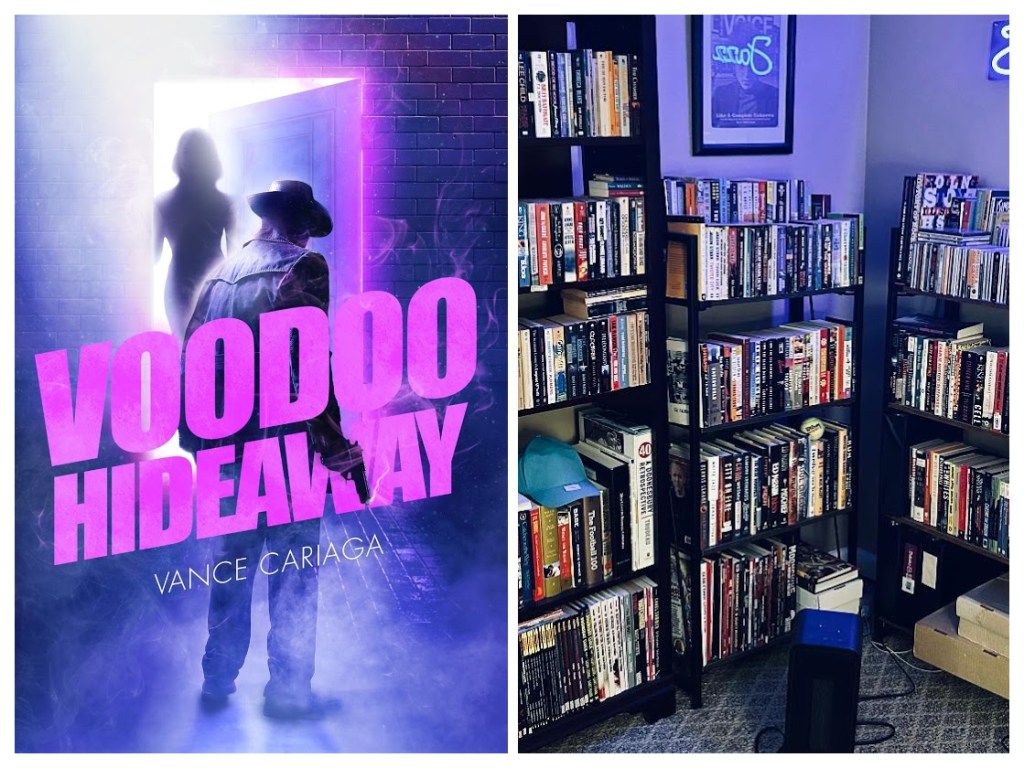
We have hundreds of books on the bookshelves in our home (the photo only shows a partial sampling). I keep telling myself that the reason I keep so many books around is that one day I hope to reread them. Some I already have – multiple times. But most, I haven’t.
That will change in 2026. I’m not going to make any bold declarations this year about how many books I plan to read, or what kind, or whether they meet the definition of classic lit.
I’m just going to spend a lot of time rereading books I have enjoyed before.
I really look forward to this. I look forward to it maybe more than any reading endeavor I’ve ever undertaken — because I’m going to read books I know I’ll like. I am 100 percent sure I won’t find them wanting after a second read, like I did with The Stand and A Man in Full.
The books I plan to reread this year will all be winners. I’m starting out with Dashiell Hammet’s classic private eye novel, The Maltese Falcon. It’s a sure winner! I’m already lining up other books in my head (The World According to Garp, One Flew Over the Cuckoo’s Nest, Lucky Jim, The Catcher in the Rye). They’ll all be great reads.
And if they’re not?
Well, no problem. I’ll have something to blog about this time next year — that doesn’t involve politics.
Image: Some of the bookshelves in my basement office, along with an excellent novel that sits on one of those very bookshelves. By an amazing coincidence, it was written by me, and you can buy it here and here and here. So buy it already!
 Vance Cariaga
That’s an excellent record for the year, Vance! Books are wonderfully cheap ways to transport us out of our lives, and help sharpen the imagination that otherwise gets blunted by so much visual input. I also miss magazines. Much of my childhood was spent browsing and reading them in stores for hours, and I had quite a collection by the time I had to move house (and sadly discarded almost all). I think “Readers Digest” (my father had a subscription) was probably the very first regular magazine I came across, and I do wish we had a physical equivalent nowadays.
By the way, “Voodoo Hideaway” is by far the most intriguing of all mentioned. I’d encourage everyone reading this post to pick up a copy today 🙂
LikeLiked by 1 person
My grandmother used to keep the Reader’s Digest on a side table in her living room and would read every issue religiously, cover to cover. Your mention of it made me check to see if it’s still around — and it is, amazingly (and encouragingly). It looks like the U.S. is the only country that still produces the print edition. Makes me want to go hunt a couple issues down in some newsstand or bookstore….
And thanks for the “Voodoo Hideaway” plug. Now we just need about 100,000 more of you. 🙂
LikeLike
I’m sure if you put out a call to your thousands of adoring Chinese fans, you could get those numbers in a matter of days 😉
LikeLiked by 1 person
Okay, that that cracked me up. Indeed — they’ll put me over the top for sure!
LikeLiked by 1 person
I also love magazines. I have a collection of National Geographic spanning roughly from 1990 to 2010. This past year I reread many of them. They have some excellent articles (and some not so much, but hey you have to get an issue out right?) I love how much the writers and the magazine invested in their work back before The Internet.
LikeLiked by 1 person
You know when I was diving back into my love affair with magazines last year I checked to see about getting a subscription to National Geographic, only to find out the regular issue is no longer available in print form. They have some Kids and History versions in print form, but not the main version. I could get the digital version but it’s just not the same. It’s too bad, because part of the allure was the great photos and designs on the glossy magazine paper.
LikeLiked by 1 person