

Here’s another blog that might (or might not) be part of a book I’m working on, about a life change I made at the age of 40, and the lessons I can impart to others. As always, you can read about the book’s background here. I wrote this blog because I needed an excuse to keep pushing forward with the book. One reason I started a book project in the first place was because my paid writing gigs had slowed down. But now they’ve picked up again (this always happens), which means I could easily ignore the book. But I don’t want to do that. And since I try to crank out a blog regularly, I figured I’d kill two birds with one stone by devoting some of the blogs to various book passages. This one begins in late 1999, after I made the initial move from my hometown of Charlotte, North Carolina, to Wallingford, Connecticut, which set off a series of events that would eventually lead to the life I have now. It aims to document what I was feeling and what I felt I needed to do, and serve as a kind of instruction manual others might follow.
When I left my old life behind to start a new one at the age of 40 – blindly, and with little forethought – it felt like I was leaping into a whole new dimension. If that sounds a little on the dramatic side, so be it. All I know is that it just seemed like a big, big change at that particular moment in time, and you know what they say about perception being reality…..
What I mainly remember is being torn between the dual dynamics of liberation and worry. Sure, I wanted to change the direction my life was barreling toward. More importantly, I needed to. But that didn’t mean I was positive it would all work out. Far from it.
These dual dynamics contributed to some very interesting mood swings. One minute I’d be scaling the emotional mountaintop, convinced I was headed for all those bigger and better things I always imagined were right around the corner. The next minute I tried to convince myself I wasn’t embarking on another colossal f**kup (not an uncommon occurrence back then).
All these thoughts took up space in my head on the 700-mile drive from my hometown of Charlotte, North Carolina, to my future home in Wallingford, Connecticut, way back in the fall of 1999.
Well, maybe it needn’t have been as dramatic as all that.
Looking back on it from the vantage point of the Here and Now, it probably wasn’t all that big a deal. Making a life pivot at age 40 isn’t exactly revolutionary. You could fill a continent with the number of people who find themselves switching gears at 40 years old – or at least thinking about it.
Research from J.P. Morgan Personal Investing found that as many as 60% of people ages 30 to 60 see the midlife period – the years spanning ages 40 to 60 – as a chance to “reinvent” themselves. My guess is that age 40 is a particularly ripe time for all this reinvention reverie. How many actually take the leap, I have no idea.
But I did take the leap.
The problem was, I didn’t have much of a plan in place to ensure that the leap was a successful one. I was more or less winging it. I had no job lined up, or even any prospects. I had no professional connections in the town, state or region I was moving to.
I was not exactly flush with cash, either. I had about three months’ worth of savings to fall back on. I needed to get very busy, very quickly, finding gainful employment. So, there was plenty of risk involved.
The one thing I knew for certain was that I was moving to live with an old friend in Wallingford, Connecticut, with the aim of landing a journalism/writing job in New York City, 100 miles away.
I’d been trained as a journalist, and had spent most of the previous 17 years working as a reporter/editor for various publications. I’d always wanted to land a writing job in the Big Apple. This move was a way to edge my way closer toward that goal.
So here’s the short version of what happened next:
About six months after moving to Wallingford, I was working as a reporter for a national financial publication in midtown Manhattan – the heart of New York City. About eight months after that, I made another move – to Los Angeles, for a promotion at that same publication, in a position that paid more money than I’d ever earned in my life.
This is how quickly the pendulum can swing, no matter your age or circumstances.
If I were to scream a life lesson from the heavens, it would be this: It’s never too late to gamble on something better. There is no term limit on improving your life. It can happen, if you have the will and the tools. There’s always hope.
We’ll get to the New York/L.A. moves later. But first, let’s outline the steps that made those moves possible.
We’ll begin at the beginning, during my earliest days in Wallingford, Connecticut.
*****
According to an internet search, Wallingford is probably best known for being a hub of 19th century silver production. I confess: I had no idea. But then, I had no idea Wallingford even existed before I moved up there from North Carolina in the fall of 1999.
When I arrived, I did learn that Choate Rosemary Hall is located in Wallingford. I had heard of Choate. It’s one of the nation’s elite college preparatory schools, and a well-known training ground for future Ivy League students.
Many of those students likely matriculated at Yale University, an A-list Ivy League school located in New Haven, Connecticut, which is about a 20-minute drive from Wallingford.
Now, New Haven (population 134,000ish) is not necessarily an Ivy League kind of town. In fact, it’s more blue collar than blue blood. AI tells me that New Haven is “not generally considered a wealthy city, despite hosting the extremely wealthy Yale University. It has a high poverty rate and a median household income well below the state average.”
I found it fascinating that one of the richest, most prestigious universities in the world is located in a town where most people have no chance at all of going to that university based on finances, connections, and educational access. I always envisioned New Haven as this leafy, upscale college town. It was quite an eye opener learning otherwise. New Haven was a microcosm of the United States itself, great wealth surrounded by great want.
But I didn’t dwell on it too much. My main priority was to scout out a place where I could get busy finding a job. Which meant heading to the main library in the nearest decent-sized city.
New Haven was that city. And as it turned out, it had a very decent public library, which I assume had something to do with its proximity to Yale. And so….
The New Haven Free Public Library was where I spent a lot of my time during those early days in Wallingford. I drove there every day with the sole purpose of researching job opportunities.
This required gassing up for the 27-mile round trip, and paying for parking. I wasn’t crazy about dipping into my savings for all this back-and-forth travel. But it was a necessary step.
Now, it’s important to keep in mind that this was 1999. If you don’t know what that means, here’s a primer: The internet was in bloom, but it was an early bloom. It had not yet come to dominate our every waking moment. It was gaining in importance every second of every day, but you could still live a reasonably coherent life without it.
I personally had used the internet at previous jobs, but only for the most basic stuff, and only on company computers. I didn’t even own a personal computer at the time.
So while there were probably websites that helped you find jobs, even back then, I didn’t own a computer that would let me find those websites – and might not have known how to go about it, anyway.
I did have access to a big public library, though. And I was an expert in using libraries.
As a news reporter in the 1980s and 90s, I spent countless hours in libraries researching stories. This required poring through old documents, periodicals, government data and microfiche files (google “microfiche”). Libraries were the Google of the 20th century. At the library, I was expert at finding the resources that would help me find the best job opportunities.
Here’s how it worked:
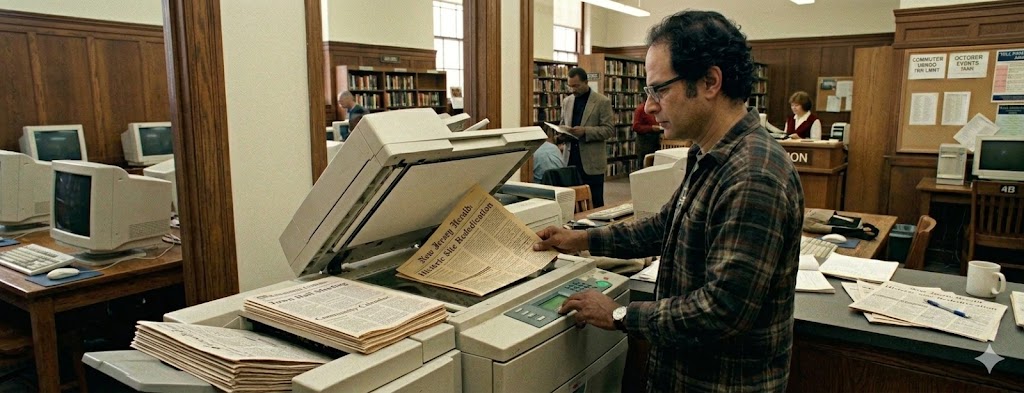
Once you’re in the library, you find the publications that advertise jobs in your chosen career field. You make copies of all those job listings at one of the library’s handy copy machines.
For aspiring writers, the most important publication was Editor & Publisher. It was the Holy Bible of the literary/media world. Each issue featured job listings across the publishing spectrum. There were probably a hundred or more listings in each issue, from across the U.S. and elsewhere.
This was back when many towns still had their own newspapers, and big cities often had more than one. New York City had four major general interest newspapers at the time, and several more niche papers. There were lots of magazines in those days, and industry publications, and business journals, and trade journals (google “trade journals”), and various other forms of print media.
In a few years, the Internet would send many of those print publications to the graveyard. But in late 1999, there were still a lot of places to work as a writer/journalist.
Another bonus: The U.S. economy was in the midst of one of its biggest hot streaks ever, driven by the tech boom of the ‘90s. We were still in the final couple years of an unprecedented 10-year economic expansion that blessed the masses with low inflation, low unemployment – and jobs galore.
If there were ever a good time to leave one job behind without having another lined up, it was the late 1990s. You could have the IQ and skills of melted wax and land a job somewhere.
*****
Anyway, I spent a great deal of time in the New Haven library researching jobs, copying job listings, refining my resume (aka CV), writing cover letters, making copies of my old newspaper clips (google “newspaper clips”), writing down addresses, and jamming all this paperwork into large yellow envelopes.
Again: This was the Dark Ages, before you could just attach a digital job application in an email or text, or go to a job site and apply online. Rare was the company that even accepted email applications. So you mailed them in via the postal service.
Every day after getting my job listings, newspaper clips, CVs and cover letters together at the library, I’d walk to the post office and mail it all off. This also required spending a good deal of money that I hated to part with. It wasn’t cheap to mail all this stuff off. But again, it was a necessary step in the process.
I probably mailed off 50 or 60 of those large, bulky envelopes in my first three to four weeks of living in Connecticut. Most went to publications in or near New York City. A few went well outside of that area, though.
I distinctly remember getting a job offer from an alternative newsweekly in Cleveland, Ohio. It was the first offer I got, and awfully tempting. I’m pretty sure I even reached out to the editor by phone. I might even have entertained thoughts of flying over to learn more.
But I didn’t. There were reasons for that, which we’ll get to some other time.
For now, let’s focus on the most important part of those first few weeks I spent in Wallingford, Connecticut: I made every single day a productive one. I made sure that I did at least one thing, every day, to move the needle forward.
I didn’t have a clearly defined plan in terms of zeroing in on specific publications and strategizing my way through their doors. But I did have a commitment to scouting out the best opportunities. I was determined to send out job application materials every day, to knock on every door possible.
It would have been easy enough to take a day off, to laze around the house, or go discover the wonders of my new hometown.
But I talked myself out it, every time. Instead, I talked myself into getting into the car, driving to New Haven, hitting the library, and poring over the job listings again.
This kind of daily commitment is important, no matter who you are. But it’s especially important when you’re 40 years old and taking one last shot at living the kind of life you always envisioned, but never quite reached. Because if you blow it this time – if you take a day off, then a week off, then the whole affair off – you will have blown more than just your time. You’ll have blown what could be your last, best chance at steering your life in the right direction.
*****
A lot has changed in the 27 years since I haunted the New Haven Free Public Library. You no longer have to deal with paper copies of CVs, cover letters or work samples. You can handle the whole process at home, digitally, right there at your computer, in just a few clicks of the keyboard.
What hasn’t changed is the need to send out those applications and make those connections – to sit down and actually do it, every day, no excuses, no days off.
Six months after I first hit the library in New Haven, I’d found a newspaper job in New York City, and fulfilled a dream. Not long after that I was promoted to a new position at the company headquarters in Los Angeles, earning a bigger salary than I dared imagine a couple years earlier
It all began with taking those first steps, into the car and down to the library. Every day. No excuses.
Image: An AI creation, attempting to replicate my copy machine experience in the New Haven library back in 1999. Although I never wore that kind of shirt back then….


Nice work, Vance. Interesting tale!
LikeLiked by 1 person
Thanks Marilyn, much appreciated!
LikeLike
Connecticut is a place of contrasts as you suggest. Hartford is the insurance capital of the US but a quick Google search will tell you it has entrenched poverty and racism too.
LikeLiked by 1 person
Very true. You have great wealth and some pockets of poverty in Connecticut, but most people think it’s just a rich person’s playground. Not at all, really.
LikeLiked by 1 person