

Suppose it’s your last day on earth, and you can spend part of it immersed in an art form of your choosing – but only one art form. Which would you choose? Would you pass a few of your final hours looking at paintings or sculptures? Dive into a favorite book? Tune into music? Take in a movie or play? Stare at statues in a Japanese garden?
It’s your day, and your choice. Maybe you won’t care. But maybe you’ll care more than you can imagine right now, reading this blog. Maybe it will take on more importance than you ever thought possible.
Now, suppose that whatever art form you choose, it will also be the only one you’ll have access to in the afterlife. You can enjoy this one art form forever. But you can’t enjoy any other. This changes things, makes the choice a whole lot harder. As much as you’d like to gaze at paintings one last time before departing this mortal coil, you might not want to spend an eternity doing so if it means no more music, or film, or literature.
Now, take it a step further: Within the art form you choose, you’ll be restricted to a specific genre. If you choose paintings, you’d have to narrow it down to something like French Impressionism, Ancient Egyptian, Cubist, Abstract, whatever. If you choose poetry, it would have to be whittled down by era and style. If it’s movies, then pick either thrillers, comedies, romance, horror, action/adventure, sci-fi, historical – you get the idea.
Think on it. Think really, really hard. Weigh all the pluses and minuses.
You might love all forms of art, but you can only choose one. You might choose poetry, but you can’t have the collected works of Langston Hughes alongside the collected works of Shakespeare. You might choose music, but you can’t have Brazilian Samba alongside Budapest Chamber Quartets. Pick an era, a genre, a style – and commit to it on your last earthly day and your forever after.
It’s an interesting exercise, yes? But not necessarily an easy one, no?
*****
Well, I know what I’d choose. I don’t really even have to think too hard about it, either. The decision would have been harder, much harder, 15 or 20 years ago.
But today? Pretty easy, actually.
First, I would choose music.
Second, it would be jazz.
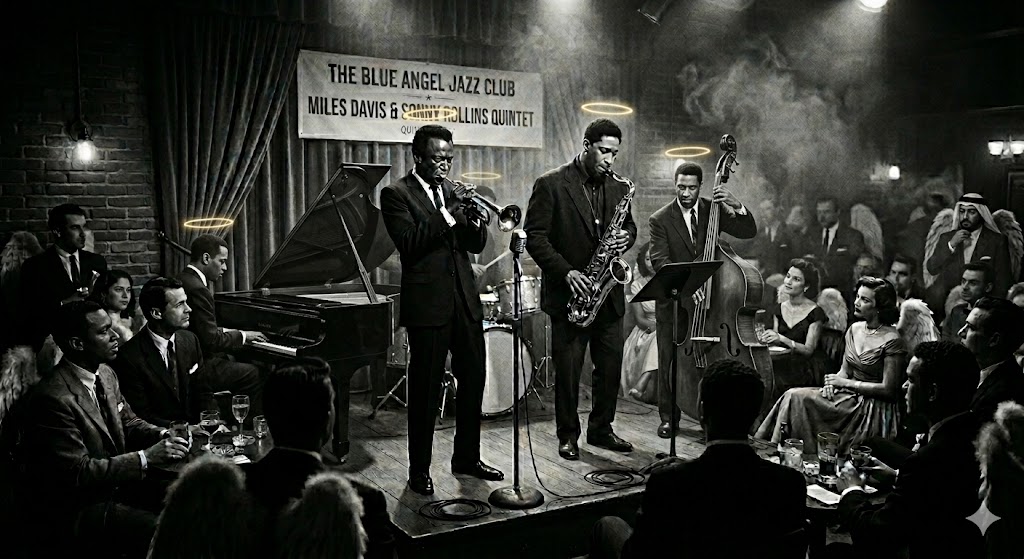
If the rule makers insisted that I pick a specific subcategory of jazz, I’d go with hard bop, the improvisational-heavy form best exemplified by masters like Miles Davis, John Coltrane, Sonny Rollins, Art Blakey and Freddie Hubbard.
If they further insisted that I pick a specific era, I would choose the early 1950s through the early 1970s.
My choice is mostly spiritual, but partly practical. There was a whole, whole lot of hard bop jazz recorded during that period, so I could listen to it for an eternity without ever running out of something fresh to the ears (I’m pretty sure). You can listen to the same performances over and over and over again and still find something you missed earlier.
Anyway, that’s my answer, for better or worse. I would have to get along with it – because I can’t imagine getting along without it.
*****
This isn’t a blog about jazz, although jazz has weighed heavy on my mind recently.
The jazz community has been spending 2026 celebrating the 100th birth year of Miles Davis, the legendary trumpeter and bandleader who changed the entire trajectory of music in countless ways, and died in 1991. He was a genius and visionary (and kind of an asshole) who is probably my favorite musician of all time, although Dylan (no first name necessary) still has a fighting chance.
This is also the 100th birth year of John Coltrane, another jazz legend, genius and visionary (and fellow North Carolina native) who was definitely not an asshole, but a nice guy all around.
More recently, legendary saxophonist Sonny Rollins died a few days ago at the age of 95. He was yet another genius and visionary, though not necessarily an asshole (even though he served time for armed robbery and narcotics). He was one of the final links to jazz’s golden age, which for 99% of the world has passed unnoticed. That’s a damn shame.
This is mostly a blog about how and why certain art forms resonate with us more than others, and the spiritual connection we develop with them.
For example, in the realm of visual arts I am much more drawn to 19th century French Impressionist painting than anything else. I was first introduced to it while taking a college art course many centuries ago. I doubt I had even heard of French Impressionism before taking that course. Today, decades later, I can still rattle off a few of the form’s famous names without googling them: Monet, Manet, Cezanne, Renoir, Degas.
I’m not exactly sure why this one painting style resonates with me more than others. Maybe it’s the colors and brushstrokes, the texture and scenes. I’m no expert at the finer points of painting – far from it. But I like what I like. And I like French Impressionism.
But I wouldn’t choose it as the art form to carry me through eternity.
*****
If I had written this blog 15 or 20 years ago, I’m pretty sure I would have chosen literature as my preferred art form both on my last day on earth and the eternity to follow. If forced to, I would have narrowed my literary choice to 20th century American crime fiction.
Again, I’m not sure I can explain why. Crime fiction just pressed the right buttons. I liked the fact that the lead characters tended to be cynical, world-weary men (mostly men, but some women) with moral compasses that didn’t always point in the right direction. The dialogue is usually crisp and clever. The pacing is rhythmic. The settings are pretty cool (dank offices, back alleys, gin joints). The plots suck me in. The writing can be fluid or choppy, but in the best of hands, it’s always literary, often ingenious.
But I wouldn’t choose it as the art form to carry me through eternity. Not now, anyway. Not anymore. It would now rank second. Which sort of amazes me.
*****
Thirty years ago, I would not even have chosen jazz as my favorite type of music, much less the art form that would accompany me into the Great Beyond. I was a rock n’ roll dude back then. Dylan was my musical idol (no first name necessary). Others on the Mount Rushmore might have included Van Morrison and the Allman Brothers, R.E.M. and the Clash, the Who and the Velvet Underground.
Jazz, I liked just fine. I listened to it often. It didn’t take the top spot, though.
But sometime between then and now, jazz took up more space in my life, mind and soul. I guess this happened when I started going to live jazz shows regularly when we lived in New York City in the mid-2000s. I kept doing so through our years in the Charlotte metro area (2008-2017), London (2018-2023) and now New Jersey, almost back in NYC, though not quite.
Live jazz became a favorite form of recreation, then an almost necessary part of my existence. It became a gift I gave myself, a break from the workaday world, the grind, the deadlines and commitments. I still go, every couple of weeks, because I can’t imagine not going.
Along with going to live jazz shows regularly, I have built up my jazz CD collection. I’ve sought out jazz radio stations. I started listening to jazz predominantly, and then almost exclusively.
At some point, jazz became the soundtrack not only of my life, but my consciousness and being. That’s not hyperbole. It’s fact. Just hearing jazz music creates a chemical, visceral reaction. It can lift me up, calm me down, center me, ground me, exalt me. The very sound of the instruments working together is like a drug that immediately puts me in a better place. It’s the nest I crawl into when everything else is suspect.
I’ve often wondered exactly how this happened. I assumed there must be some kind of science behind it. And yes, there seems to be. Not just jazz, but music in general. To wit:
- According to a journal from Harvard Medicine, the acoustic cues you get from music travel through the ear and into the temporal lobe, which parses the soundscape, identifies sounds, and tags their components as familiar or unfamiliar. The salience of these sounds….influences the autonomic nervous system (ANS)…The valence of the music, which signals whether the music feels positive, negative, or somewhere in between, influences the ANS, too.”
- From Psychology Today: According to predictive coding, the musical qualities we learn to value inform a certain brain system [called] the reward prediction error system (RPE)….As we listen to music, the auditory regions of the brain make predictions about upcoming sounds and share those predictions with the reward system. The RPE becomes active when the actual music differs from what was anticipated. This mismatch generates emotions and feelings.
Well, it’s all very academic sounding – and maybe over my scientifically-challenged head.
All I know is that for whatever reason, and for time immemorial, music and other art forms have been a driving force in the human experience, no less important in some ways than oxygen and food, helping us navigate the peaks and valleys, bringing joy and pain – but rarely indifference, if we’re lucky.
We don’t know what the next world will bring. But we can only hope it includes something akin to the artistic experience. Without it, what’s the point?
Image: AI-generated, with instructions to create an image of Miles Davis and Sonny Rollins, leading a quartet in some jazz club afterlife.
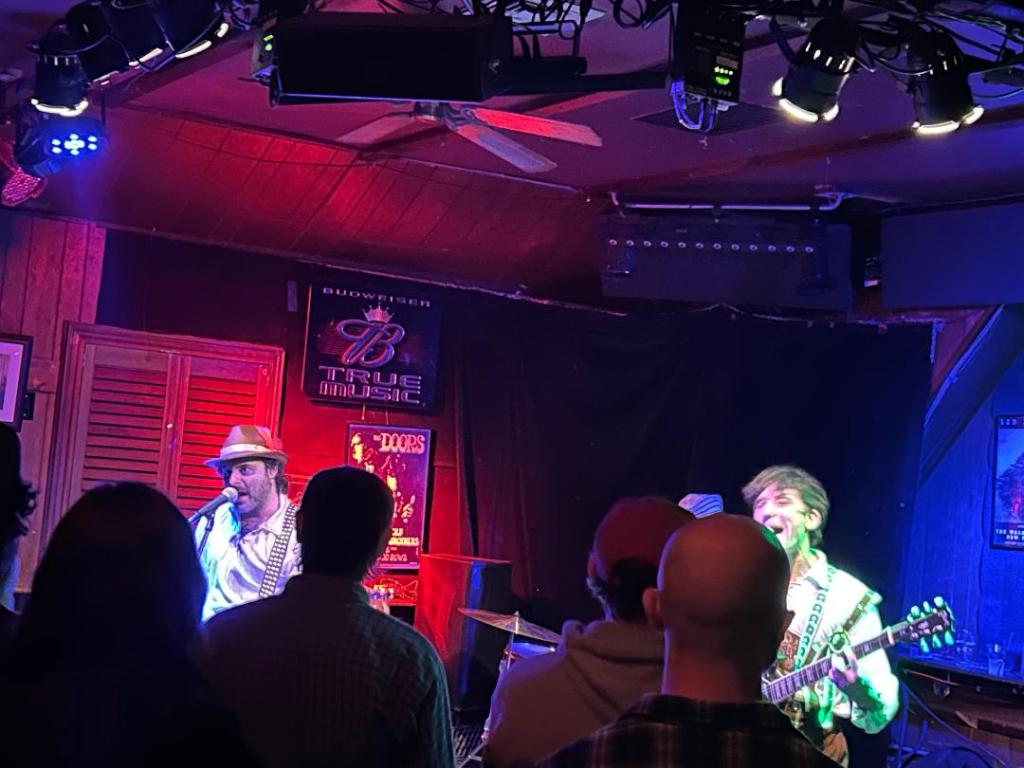
Postcript: As luck would have it, I had a Daddy’s Night Out in the middle of writing this blog, and went to a local watering hole I frequent sometimes. Little did I know that it also has an upstairs section where live music is played. Tonight I heard some 90s, Green Dayish punk wafting from upstairs, so I decided to give it a listen. Like Green Day, this group were a trio. And they were pretty GD awesome. This was the first live rock/club show I’ve seen in I don’t know how long. It reminded me of why I used to love rock n’ roll so much for so long, and restored my faith in it. Below is a photo of the band, whose name I don’t know.


The science is definitely interesting. I also wonder whether what you’re exposed to in childhood shapes your grown up tastes. For example, there are songs I didn’t like or thought average in childhood, but now when I hear them (in real life or just my head remembering), they’re actually not bad. As for the limitation scenario, I guess I don’t need to choose because my beliefs about the afterlife assure me that we’ll have anything we want, and to degrees way better than the earthly versions. So, I’d choose as much as I want, with frequent variety, because too much of a thing would be tedious…
LikeLiked by 1 person
That’s an interesting point about childhood memories. My father would occasionally put on jazz when I was a kid, and my mother would listen to artists that had some jazz connection, though they fell more into the pop/crooner category. So maybe that has something to do with it (although, truth be told, we kids controlled the car radio, which was pretty much always tuned to the rock/soul station).
I get your point about the afterlife, and I figured somebody would bring that up, that we won’t have to choose.
But in the Heavenly Kingdom of my blog, you have to make a choice. So…..what’s your choice? 🙂
LikeLiked by 1 person
If pushed, I’d probably go with movies, since they’re the most immersive form. I’d probably choose fantasy or epics, within that category. Something like Lord of the Rings.
LikeLiked by 1 person
That’s interesting to hear, thanks for sharing. I’d miss movies for sure. But as you say, this is just a hypothetical exercise. I’m sure in the afterlife we’ll have a bounty of all artistic pursuits, or at least something comparable.
I was wondering if you’d choose poetry. But my hunch is that while you’re a practitioner of it, you might not necessarily be a lover of others’ work. That probably happens a lot in the creative world.
LikeLiked by 1 person
Yup I actually don’t read that much of it, and often struggle to interpret the meanings. Maybe it’s unprofessional or impatient of me, but nobody can dictate what you enjoy most, and for me, poetry is all about feeling.
LikeLiked by 1 person