

Here’s another installment of a book I’m writing in my spare time, about my experience adjusting to major life changes beginning at age 40, including getting married, having kids, and living overseas. Prior installments can be read here and here and here. This one details my experience adjusting to living in London when we moved there back in early 2018, and I had just passed my 59th birthday. This has been a particularly hard chapter to write, for whatever reason. Having completed it (mostly – I’ll polish it later), I’m now at about 19,000 words into the book. I’m aiming for 70,000 words. So that means about another 50,000 words, which seems impossible. I’m not sure my experience has another 50,000 words in it. But we’ll see, we’ll see.
Getting adapted to living overseas can be really simple, excruciatingly difficult, or a thousand shades in between. It all depends on the attitude you pack along with your luggage. You can overthink it, for sure. But you can also underthink it. You can either decide it’s a major life event that could make or break you, or just another day in the life.
I’m not sure I’ve ever met the latter, though I’m sure they exist. I have known the latter – plenty. People who overthink it. They don’t even need to be moving across an ocean to another continent, either. They can move one county over, 11 miles away, and take the stress level to a point where it breaks the universe entire.
I guess I fell somewhere in the middle, because I always fall somewhere in the middle. I had the requisite amount of stress. But I also reminded myself that billions of people had done the same thing before, so how hard could it be?
What I mainly focused on was adopting the right mindset. And here’s what I decided was the most important thing to do before moving to another country: Locate the part of your brain that contains your home country’s rules and customs, gently remove it, and toss it into a drawer until you need it again.
You’re not going to need or want that part of your brain when you become an expat. It will only get in the way, cause problems. It will nag and complain, bitch and moan, tell you that the place you’re moving to makes no sense, doesn’t do things the right way. You don’t want that, trust me.
You might not experience this sensation when you first land overseas, this little voice screaming that you’ve moved to a strange place that has everything all wrong, from the way it drives to the terms it uses for “band-aids,” “potato chips,” “sneakers,” “flashlights,” etc.
No, that will only come later, after you’ve had time to absorb the immediate shock of moving so far away in the first place.
When you first arrive, you’ll be so busy and exhausted that your main focus will be on the here and now, the immediate mission, how to get where you need to be. You don’t have the time or energy for much else besides finding your living quarters and unpacking.
We arrived in London from Charlotte, North Carolina, on a redeye flight. It left at around 7 p.m. East Coast time and landed at around 8 a.m. London time. We left at dinnertime and arrived during breakfast, on a flight that only spent seven or so hours in the actual air.
Have you ever tried to sleep on an overnight flight, a redeye? One that crosses an ocean into a different continent, five time zones away?
What happens is, you spend the first couple of flight hours settling in, getting your seat position just right, making sure your phone apps are in good working order. Then comes the dinner service. When that’s wrapped up, you’ve probably been in the air for three hours or so. Let’s say it’s 10 p.m. East Coast time. The dinner trays have been collected and taken away. The cabin lights are dimmed.
Now is when you might try to doze off. But unless you normally fall asleep at around 10 p.m. (which I don’t, ever), then it’s hard to doze off. So you read, listen to music, or watch a movie.
Around 11:30 p.m. East Coast time – 4:30 a.m. London time, more than halfway through the flight – you finally feel yourself getting a little drowsy. Maybe you even drop into one of those half-sleeps. But then…
But then….
About 90 minutes later – BANG! – the cabin lights come on (brightly) and the flight attendants announce (loudly) that breakfast service will begin. Whatever sleep you’ve managed to corral has been violently interrupted by most obnoxious sonic/illumination explosion you can imagine. It’s 21 times worse than an alarm clock.
So, you’ve had maybe (maybe) two hours of sleep. In my case I’m not sure I even dozed off for an hour.
But now, in a flash, you have to get into a whole new mindset: Preparing yourself for arrival. Filling out custom forms. Locating your important documents – and your brain.
After the flight lands and pulls to the gate, your journey is maybe two-thirds over, at least mentally. That’s no lie. Your plane departed about eight hours earlier, but that was only the first couple of acts. The third act involves:
- Crawling off the plane.
- Standing in the customs queue, which never ends.
- Providing 43 different types of identification.
- Telling the customs agent who you are, where you’re from, what you’re doing here, what you plan to do here, where you went to university (really), what you do for a living, where you were born, where you’ll be staying, where else you’ve been traveling, where else you plan to travel (really), how long you plan to stay, who else came with you, what your favorite color is (not really) – oh man, the questions these people ask.
- Doing the fingerprint thing, which seems to malfunction about 73% of the time, meaning you wait and wait and wait until the machine finally decides that your fingerprints are what they should be.
When you finally make it through customs, you now have to walk what seems like a couple of kilometers just to exit the airport (well Heathrow, anyway), and find the taxi queue.
Then it takes you 90 minutes in a taxi (I kid you not) just to get to your destination way over on the other side of town, because London Heathrow is located forever away from any other part of London where most people actually work and live.
So……
You’re exhausted. Brain dead. Dead dead. Useless as a living organism.
All you want is to be inside your hotel or apartment, toss your luggage on the floor, and zone out for a while. But you can’t. Because now you have to put everything up, and find the nearest market so you can eat, and tend to 480 other pieces of business.
Which means you don’t really know or care about all the future stuff that involves getting accustomed to a new country, a new culture, and new rules. Right now, none of it matters. You just don’t care.
Your brain is fried. Your body is empty.
A well-deserved sleep awaits.
That’s all you want. A well-deserved sleep.
*****
After that first night’s long sleep, we spent the next couple of days getting the lay of the land. We had a temporary apartment near my wife’s office, so we needed to investigate the immediate surroundings. The apartment was located in a high-rise building in Canary Wharf, a modern business/financial hub located in East London, within a loop of the River Thames, on the Isle of Dogs.
If you’re new to London, you don’t know that Canary Wharf’s gleaming office towers and crisp, streamlined walkways are not at all like the rest of London. You also don’t know that many natives look down on Canary Wharf and its aggressive, 21st century mindset. You also don’t know that one day your American self will find great comfort in Canary Wharf, because it strikes a familiar note, and provides a refreshing change of pace from the rest of this ancient old city.
We had no plans to settle down in Canary Wharf, though. We wanted to be in a part of London that was more family-oriented, with good schools for our young daughters. We also needed easy access to the Jubilee tube line that runs into Canary Wharf, so my wife’s commute would be reasonable. This meant scouting around for permanent apartments elsewhere in town. (I personally could live and work anywhere, since all I needed was a laptop and internet connection to do my job).
On the recommendation of my wife’s work colleagues, we looked at a few apartments in the Bermondsey/Rotherhithe area of southeast London, which is heavily residential, but still very close to the Jubilee tube line.
As luck would have it, the first place we looked at, a 3-story townhouse, checked all the right boxes, at least in my eyes. Let’s review those boxes:
- It had a small, fenced-in backyard (or “garden,” in Brit parlance). This was very important, because we needed outdoor space, being Americans from the ‘burbs.
- It had four bedrooms, which meant sufficient rooms for the family, plus one that could be used as an office.
- It had three levels, which meant we wouldn’t constantly be tripping over each other.
- It was roomy as these things go (massive urban areas like London are not renowned for tons of living space).
- It was in an area with excellent schools.
- It was right by the Thames, with beautiful views.
- It was within easy walking distance of the bustling Butler’s Wharf/Tower Bridge/London Bridge area.
- It was a 6-minute walk from the Bermondsey tube station, which is on the Jubilee line to Canary Wharf.
- It had markets, pubs, convenience stores, medical offices and plenty of parks you could walk to.
We looked at a few more places after this first one. But we’d already found where we wanted to live, and were lucky that the perfect home was available to rent. About a month or so after moving overseas we signed a lease and got the kids enrolled in school.
*****
I touched on this topic earlier in this book, but let me just repeat it here, because it’s important…
One of the biggest concerns I had moving into a new land was how our daughters would adapt. This kept me up at night for weeks and weeks, I can’t even tell you. Our daughters were ages 8 and 6, and perfect (damn right). We were asking them to leave behind friends, family, school and the comfort of home. They would have to adjust to a new home and school (right in the dead of winter, mid-school year), meet new classmates with different accents and different sets of experiences, and adapt to a new way of learning. My biggest fear was that they would have a hard time fitting in. That they would sit in the corner somewhere, ostracized and isolated.
That’s a parent’s nightmare. The ogre in the closet; the monster under the bed. The one thing you can never forgive yourself for.
But as it turns out….
….we needn’t have worried.
The first day of school, as we walked our daughters onto the grounds, some very nice kids hustled our way, asked our daughters if they wanted to be friends, and whisked them away smiling. And that was that.
My suspicion is that school staff alerted some of the kids that new students would be arriving from America, and that they should be made to feel welcome. And it worked. It worked! Our daughters made new friends, adapted quickly, and settled right on in. Kids have a way of doing that.
But adults?
Specifically, adults who were older parents and charging hard toward their 60th birthday (like me)? How would they adapt?
How would I adapt?
How on earth would I adapt?
Well…..
*****
Let us now return to the original point of this chapter: Locate the part of your brain that contains your home country’s rules and customs, gently remove it, and toss it in a drawer for later use.
I took that to heart. I really did. I decided early on that I was going to do my best to throw out the old ways and embrace some new ones. My aim was to observe and adjust for a while. Watch people, see what they do, how they react in certain situations, get a sense of what pleases and annoys them. Study the rhythms of the city. Listen in on conversations. Read the room. Learn the country’s various ticks and tocks.
What I didn’t want was to let myself become one of those folks who simply can’t believe this strange new place doesn’t do things exactly the way we did it back home. This is natural human behavior, by the way. It’s hard to embrace the new. It’s especially hard when you have several decades under your belt, as I did.
Luckily, I had a couple things in my favor on this end, even at my ripening age.
For one thing, I was a writer and journalist by trade. That’s a good professional background when it comes to navigating new worlds. One of the keys to being a decent writer and journalist is developing keen observation skills. You spend a lot of time watching and listening. You learn to notice things, pick up information just beneath the surface. That came in handy.
Also, I had personal experience adapting to different places at a fairly late age. I was a Southern boy who found myself moving to the Northeast, then West Coast, then back to the Northeast after I’d already turned 40 years old. Moving from one region of the same country isn’t exactly like moving to another country or continent. But it’s similar. There are very distinct cultural differences between all the different regions in Big Old America, and it takes some adapting. So I had those experiences to tap into as needed.
Oh, and there was one more thing rattling around in my head when I decided I wanted to adapt to the new land like a proper guest.
Before we moved to London, we were introduced to an American couple who had spent a couple of years in London themselves. We hoped to pick their brains, get a few tips, some positive advice we could take along before we set off across the Atlantic.
Instead, it was two hours of them bitching about London. It turned into a non-stop laundry list of grievances and complaints, how this sucked about London, and that sucked. How they hated that, and this, and this, and that, and this/that/that/that/this. Man, it was tiring. At some point I basically said, “We get that you didn’t like it. But we’re moving there. So can we just stop with all the negativity?”
I think they were surprised. And probably offended. But I didn’t care.
And I also decided, then and there, that I was not going to be one of those people. I was not going to move to another country and dig around for every little thing that bothered me. Instead, I was going to keep an open mind.
And really, it was the opportunity of a lifetime, moving to London. Millions of people the world over have lined up for the privilege of living in a city like London. Many, if not most, are turned away, because London only has so much space. We were lucky to have the way paved for us.
The couple we met were lucky, too. They just didn’t realize it – or appreciate it. They took what could and should have been an amazing experience and turned it into an ordeal.
Which is beyond sad.
*****
As an American expat living in London, I did have certain advantages. For one thing, we speak the same language. For another, America and the UK watch a lot of the same movies and TV shows, listen to the same music, and enjoy many of the same sports. I watched an NFL game and a couple of major league baseball games while living there. From a cultural standpoint, it was not nearly as big a leap as I would have experienced anywhere in the world not named Canada or Australia.
And, there’s this: The long arm of American commerce stretches far and wide in the world in general and the UK in particular. One of my first impressions of London was that you see all the familiar logos and storefronts you see back in America, pretty much everywhere – Starbucks, McDonald’s, Burger King, KFC, Pizza Hut, Five Guys, Shake Shack, etc.
It wasn’t like I was living in some completely foreign and exotic land.
But there were a few differences. The UK name for “band-aids” is “plasters.” Over there, “sneakers” are “trainers.” Our potato chips are their “crisps.” I could go on, but it’s all been written about before, about 4.8 million times.
Anyway, that’s all minor stuff. Something that takes about 90 seconds to get used to.
I did have some stumbles along the way, though. I did have moments of longing for the familiar, the American way of doing things. Sometimes I privately raged about London’s quirks. I even blogged about one especially crappy night.
But in public, among the masses, I kept things pretty well in check. I didn’t let my mind get closed, or my attitude get soured.
I eventually settled into the London way of doing things, and even came to like it. To this day, I find myself missing the very London vibes I once had to spend great energy adapting to.
In fact, there’s much I came to miss about London. In fact, as I write this, I find myself having to admit that in some ways, adjusting to Northern New Jersey USA has been a longer and harder struggle than adjusting to London, but that’s another tale for another day.
The main lesson is this: I decided early on to accept that I was a guest in a new land, and that I wanted to be a good guest. A smart guest. A gracious guest.
I didn’t always succeed. But I succeeded more than I failed. And that made all the difference.
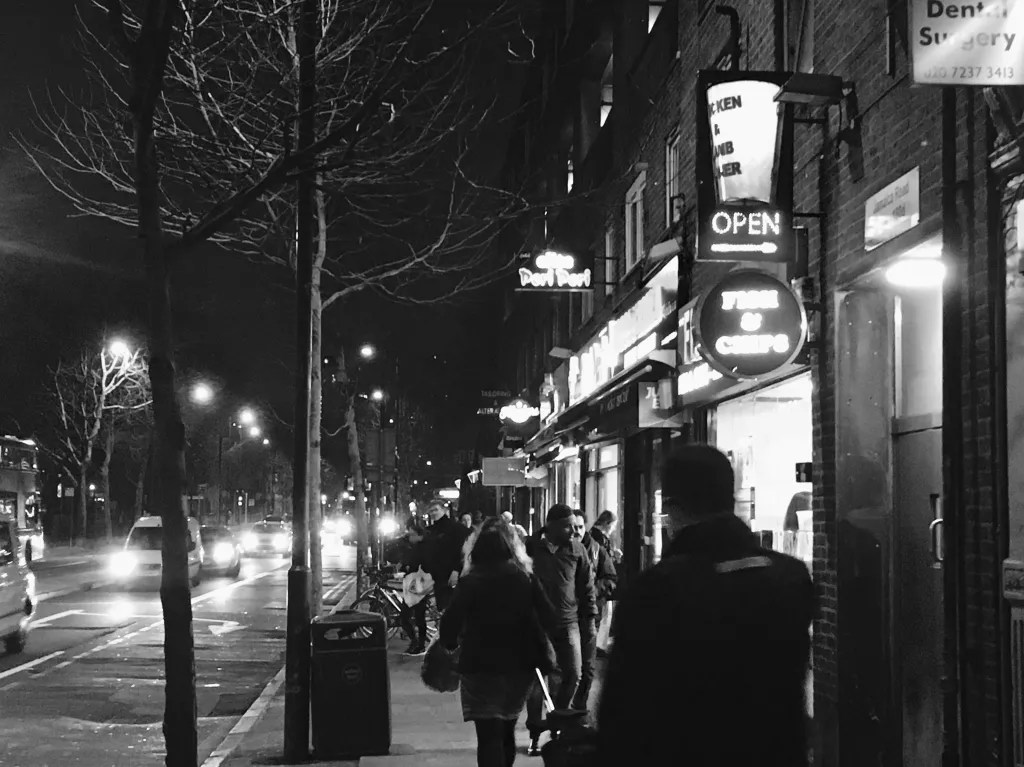
Image: A photo my wife took during our stay in London. She’s a skilled amateur photographer, and I feature her work in this section of the blog. This is one of my favorite shots she took, of Jamaica Road in Bermondsey, just a short walk from where we used to live.

