

“You know one thing about us wise guys? The hustle never ends.”
The above words were famously spoken by fictional New Jersey mafia boss Tony Soprano early on in the HBO crime series, “The Sopranos,” just before Tony whacked a former mobster turned FBI informant who was trying to hide out and start a new life in rural New England.
In this context, “hustle” refers to a life of organized crime. Once you’re in it, you’re in it for good. You can’t just walk away from it and start anew, maybe open a roadside strawberry stand and live the rest of your days in peaceful, anonymous bliss. That’s not an option.
The same theory can apply to other, less menacing pursuits. Maybe you won’t get strangled by some old mob connection. But you can’t just walk away. The hustle will find you, no matter where you are.
It certainly applies to the publishing world, at least when you take up residence in the “author” part of that world.
The hustle begins when your name goes on a book and that book gets registered with the copyright office. The book will typically show up on Amazon and other retail sites, with an International Standard Book Number (ISBN). After that, you promote it on social media and other platforms.
Suddenly your name and book are in God knows how many databases. Soon enough you’ll be hearing from people from all over the world promising to turn your book into an international bestseller – as long as you’re willing to fork over a little money, of course.
I have two books out right now – one self-published (Money, Love and Blood), and the other (Voodoo Hideaway) put out by a vanity publisher that required me to pay some of the upfront costs. The first one was published in 2017; the second in 2021.
In the years since, I have been contacted by hundreds (thousands?) of folks trying to separate me from my money in service to my books. Some emailed me, some called, some texted, some reached out over social media or other places. To this day, my junk mail is filled weekly with dozens of new offers from dozens of trolls, bots, hustlers and scam artists.
Early on as an author, I took the bait. I suck at promoting my books, like many writers. So, I was willing to part with some cash to have others take care of that end of the business. I didn’t spend a ton of money. Maybe a few hundred dollars or so. But I did enlist some of these people to promote and/or review my books, with promises of amazing exposure! and a big boost in sales!!
Those efforts (and my money) resulted in enough additional sales to buy me a cup of coffee and a toasted bagel. Maybe.
This is a common theme in the book world. There’s an endless supply of writers out there, and many are just delusional (and egotistical) enough to believe their books are works of genius that will enthrall millions of readers. With just a little promotional help, the sky is the limit!
Then reality hits – quickly.
If you want a sad fact to nibble on, here’s one: According to one analysis, more than 90% of self-published/vanity press authors sell fewer than 100 books. The average is around 250, total.
Even so, you can bet that there are thousands of book promoters out there hustling, trying to convince you that you’ll be one of the few who break through into the big time.
*****
Recently I got another in an endless stream of book promotion queries, from someone who seemed comparatively legitimate, as these things go. This person has written books, achieved a certain level of minor-league fame, and been profiled in the media.
(Before I proceed, a quick note: I will refer to this person as “they” and “them” so as not to reveal a gender or any other identifying information. I don’t want to drag their name through the public. I’m sure they’re nice enough people, even though they tried bullshitting me more than once).
I won’t go into how I was approached by this person. I mainly want to share some perspectives on how these hustles work.
The short version is this: For $300, this person was going to provide some promotional services to help build buzz for Voodoo Hideaway, a crime novel. The person said they had read the book. They were impressed! They saw great potential! Let’s do business!
Now, normally I would have politely declined this offer. Just about every day I get contacted by some nobody on some laptop, offering to promote my books without even mentioning my name or the books themselves (e.g. Hello, dear author, I can’t help but be excited about your book…..).
But the aforementioned query was not like that. This person knew my name. They knew my books. They shared a list of their own literary accomplishments, which I confirmed though the magic of the internet.
Well, we traded some correspondence back and forth. I even asked if we could chat on the phone to discuss further, but was told that digital communication was best (kind of a red flag).
In the end I didn’t have a good feeling about it. This person was heavy on the jargon and promises and promotional gabba gabba, but short on the details.
I weighed their offer and said nah, I think not. I explained to them my previous experiences with this kind of thing, and how those experiences ended up being a waste of time, money and effort.
But this person kept pushing ever onward. It went on for days and days. After a while I got to thinking, This sure is a lot of work on their part for three hundred bucks. What’s the real game here?
Here’s part of our exchange, shortened for clarity:
Me: I’ll be in touch about it and let you know how I want to proceed. I just have to consider all this for a couple days, let it marinate in my brain.
Them: I completely understand wanting to take some time to think everything over… However, I also feel there may not be much reason for us to wait since we already have a clear idea of what needs to be done. Starting the process earlier would simply help us move things forward and allow the work to be completed faster.
Me: I know you need to get on with your business so I think for now I’ll take a pass on this. If I decide to revisit it in the future I’ll let you know.
Them: Based on our discussions so far, my primary concern is implementing strategies that are proven to build visibility, increase sales, and reach the right audience. If readers understand the value of the book, it is unrealistic to expect no action. Let’s assume we reach 100,000 readers—there’s no scenario where we broadcast to that many people and none respond; it’s simply not possible…I would welcome moving forward with a clear plan designed to maximize both visibility and sales.
Me: Give me an idea of how you track all this engagement, and what metrics we can expect to see, and on which platforms, and how all this data translates into book sales.
Them: Engagement is measured through indicators such as views and link clicks, which show how many readers have been introduced to the book and how many chose to learn more about it…These engagement metrics provide a clear indication of reader interest and the traffic directed toward the book.
Me: I figured social media would need to play a big part, which is problematic because I have very little social media exposure anymore… I guess I was open to conversations with you because of your connections in the book industry, thinking maybe there was a way to open up avenues to traditional publishers or agents.
Them: Regarding your message about pursuing publishers or agents, there is indeed a way forward, which I have been explaining…I am confident in this approach. In short, there is a strategy that can help move things in the right direction. Can we proceed?
Me: I guess I’m confused about the way forward in securing a publisher and agent, and what approach it involves. I’d love a little more clarity on how exactly we might approach publishers or agents, and secure one or the other.
Them: What I want you to know is that I’m also an author, and my books are doing well. From my own journey, I didn’t rely on a publisher or an agent. Instead, I learned the process myself and handled things independently because I believe sometimes no one can represent your work with the same dedication as you can.
Me: Since you said you read Voodoo Hideaway, what is our targeted audience for it, and how will we reach them? I’m interested in how specific characters, scenes and story arcs might appeal to a specific type of reader — not general comments about mystery or hidden secrets.
Them: From my reading of Voodoo Hideaway, the book feels particularly suited for readers who enjoy atmospheric, character-driven mysteries where the setting and personal motivations gradually shape the unfolding story. The tension surrounding the hideaway itself, along with the moments where the characters’ hidden motives and past experiences begin to surface, creates the kind of slow-building intrigue that many mystery readers find compelling. Scenes where emotional tension and secrecy intersect tend to resonate strongly with readers because they make the mystery feel personal rather than purely plot-driven. That combination of atmosphere, character conflict, and gradual revelation is what can naturally attract a wider readership that enjoys immersive suspense.
Me: Thanks for taking the time to share your thoughts. For now I think I’ll take a pass, but if that changes I’ll let you know.
Them: Oh, hope there’s no problem?
Me: There’s no problem. I do harbor doubts that you actually read Voodoo Hideaway, based on the fact that you didn’t name a single character, scene or plot point that jumped out at you. Those are important considerations, because there is a very specific type of reader who would be interested in this type of book. I know these readers, because I am one of those readers. They would largely fall into a certain age group, education level, cultural background, etc.
*****
Here’s what stood out for me in the above exchange: Whenever I asked for specifics, such as how we might corral a publisher, or what they liked about Voodoo Hideaway, I was given a steady string of generic industryspeak. It became clear that they never read the book and that I was being hustled, yet again.
I tried to be a good sport about it, though. Since this person spent a lot of time communicating with me, and put a lot of effort into winning my business, I offered to send them $20 via PayPal.
That’s when a couple of major red flags went up.
First, I figured they’d decline my payment offer. But no. Instead, they thanked me, and said I should send the payment to their “manager.” They then requested a screenshot of the transaction.
Red flags, red flags.
I let them know I would never, ever send a screenshot of any financial transaction to someone I don’t know, because it exposes all kinds of potentially sensitive financial information. I also wondered why they needed a “manager” to accept a payment for 20 lousy dollars.
Long story short: I didn’t send the payment. I wished them well, and told them we were done here.
It was a learning experience, if nothing else. Hustlers come in all shapes and forms – and this one, I have to say, was a lot better at it than most. They almost hooked me.
But at the end of the day, they were feeding me a heaping helping of horseshit, just like the rest.
There will be others, you can bank on it. My inclination is to swat them away like so many flies. But you never know. Maybe one or two will hit the right wavelengths, and convince me that this time, finally, I’ve found the one who will take my work into the literary stratosphere, where it goddamn well belongs.
I’m a writer, after all. And there’s no point in being a writer if you can’t convince yourself that you belong in the literary stratosphere.
They’ll come for me. And keep coming, and coming, and on and on. If you’ve written a book, they’ll come for you, too.
Because the hustle never ends.
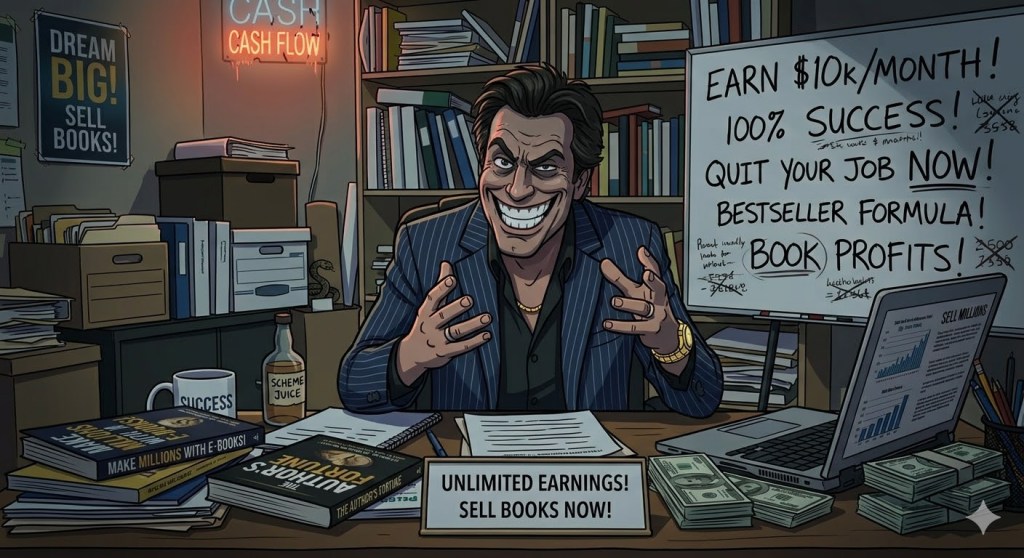
Image: AI, with a dark, DC comics vibe.
 Vance Cariaga
Hi Vance This is very enlightening and disturbing. I’ve heard similar stories about bogus promoters from other authors. Thanks for sharing this information. I hope the ride gets smoother as you go along.Cheers,MM
LikeLiked by 1 person
Thanks Marilyn! Yep, it’s definitely disturbing — especially when someone I don’t even know requests that I send a PayPal payment to their “manager,” who probably doesn’t exist, and then take a screenshot of the transaction for their eyes to see. That was the final straw right there. I’m not even sure this person really was who they said they were.
There are millions of hustlers and fraudsters out there, every minute of every day, trying to weasel their way into someone else’s money. That’s why I automatically delete every single query about wanting to promote my books.
The hustle never ends……
LikeLike
I am so sorry you’re running into these issues. You’re a fighter and I know you’ll come out of this as a winner.
LikeLiked by 1 person
Ah, it ain’t no big thang. I’m not the least worried about it really. I just find it fascinating how many people are determined to screw everyone else over.
LikeLike
So true
Sent from Yahoo Mail for iPhone
LikeLiked by 1 person
The bit: “Scenes where emotional tension and secrecy intersect tend to resonate strongly with readers because they make the mystery feel personal rather than purely plot-driven. ”
Was a dead giveaway that this person was using AI for the responses. That’s exactly the sort of thing the machine spits out, and it’s a sad reality that these scammers are getting an easier ride using the technology.
But you’re wise enough to spot the fakers, so I trust you’ll be alright. Really, I would think the most direct route to getting that exposure to hit the big numbers is making personal connection with actual agents and publishers in that genre. Which would require the sort of dedicated consistency you spoke of in your last memoir snippet.
Social media metrics and online exposure don’t really translate to real numbers, I would think. Reaching the real life influential people – the traditional way – still seems the more effective way. And I believe you can make a pretty good run at that if you could throw yourself completely into it. (Which I realise isn’t so realistic, given work and family commitments.)
LikeLiked by 1 person
You’re absolutely right on 2 key points: AI is making it a whole lot easier for scammers, and social media is the most overrated thing in the world when it comes to selling books.
In a way, AI also makes it easier to spot the scammers. I can tell within 2 sentences whether someone is trying to feed me a load of AI-generated crap. So far, all of them have been trying to feed me a load of crap (AI-generated or not). Every single one.
The difference when I was a newly published book author is that I felt like I needed to spend some kind of money on promotions, so I just closed my eyes and leaped. No regrets, really. But it hasn’t happened in a long time, and it’s never going to happen again. If it’s not a legit agent or publisher reaching out, I have no interest — and neither should anyone else, which is partly why I wrote this blog.
As for the social media stuff: About 1 in 100,000 people are actually good at it. And being good at it means spending all day with your head stuck in your laptop/smartphone, pretending to be someone you’re not. I have no appetite for that, either.
At the end of the day, the most important thing is to just do the work, write the books. There’s a feeling of accomplishment that comes with that. It was definitely a box I needed to check in my life. Probably you as well. 🙂
LikeLiked by 1 person
Hey Yacoob, speaking of books…..
I saw your Substack post about how your book “Let It Flow” was picked up by the Columbia University library. I wanted to comment but for some reason I can’t navigate the comment process on Substack, and I haven’t seen you write about it on WordPress. Anyway…..
Congratulations! That is truly impressive. I’m not sure if you know or not, but Columbia is one of the premiere universities in the country (and world, probably). It’s an Ivy League school, which means it sits up there alongside Harvard, Yale, Princeton, etc. So having a book in one of their libraries is quite the honor.
Oddly, I have never been to Columbia even after living in and around NYC for many years off and on. It’s probably only 45 minutes or so by train from were we currently live. I’ve always wanted to check it out. If (when) I do, I’ll try and drop into the Butler library to find your book.
Congratulations again — truly impressive.
LikeLiked by 1 person