

Imagine waiting nearly a quarter-century for something you deemed important to happen – in fact, desperately wanted to happen – and then all but ignored it the very day it could have happened.
Imagine tuning it out while millions of others tuned it in, all because you couldn’t bear the thought of watching it.
Imagine how that might change your entire perspective on what you once thought you held dear.
This was me on Sunday afternoon, during the men’s singles final of the U.S. Open Tennis Championship. I barely paid attention to it – even though I’m a huge, U.S.-born tennis fan, and had a chance to see an American man win a major singles championship for the first time since 2003. This was such a big deal to me I even blogged about it a few years ago.
It should have been an epic moment. Instead, it was a lesson in how we categorize what’s important – all the way up to the moment when we discover it wasn’t that important after all.
*****
This year’s U.S. Open final pitted Ben Shelton of the United States against Alexander (aka Sasha) Zverev of Germany. Shelton was the decided underdog, having never beaten Zverev in five previous meetings.
But Big Ben had been on a hot streak of late, winning an important tournament in Canada over the summer, and taking out 7-time major champion Carlos Alcarez in the U.S. Open quarterfinals (yes, Carlos had been off the tour for months dealing with an injury, and Shelton still needed a fifth-set tiebreaker to beat him, but still….).
The U.S. Open final between Shelton and Zverev was potentially historic beyond just the fact that an American man had a chance to end a 23-year major championship singles drought.
With a win, Shelton also would have been the first African American male to win a major title since 1975, when Arthur Ashe won Wimbledon (well, partly; Ben is mixed-race). No black man anywhere has won a major tennis title since 1983, when France’s Yannick Noah won the French Open.
So there was a lot at stake in this match. And normally I would have been glued to the TV, watching every point.
But not this time. Instead of being glued to it, I only caught bits and pieces. Every so often I’d break away from the football game I was watching and pop into the tennis match. But I never stuck around for very long.
The fact that I even wrote the above sentences is sort of insane, given my long love affair with tennis.
I’ve played and followed the sport religiously since 1971, when my parents bought me a Wilson Jack Kramer wooden racket. In no time at all I found myself spending countless hours at the local tennis/swim club, pounding the ball back and forth, back and forth, with anyone who wanted to play.
I played a number of junior events as a youngster, got pretty good at it, and continued to play anyone, everywhere, for decades. Even now, I rarely miss a day hitting the tennis ball.
Beyond that, I also watch tennis pretty much every day. I pay yearly subscriptions to both the Tennis Channel and Tennis TV, and catch matches at all professional levels on whatever device is handy (TV, laptop, iPhone).
I can probably name 40 of the world’s top 50 male players off the top of my head, and maybe 60 of the top 100. I’m not sure I can name 30 players in any other sport, even though I used to be a major fanatic of baseball, football and basketball.
From a fan standpoint, men’s tennis is the only sport in which I still have a decent level of expertise. And being a tennis expert, I know that the last time an American man won a major singles championship was in 2003, when Andy Roddick captured the U.S. Open title.
Since then, they’ve been shut down and shut out. Nearly a quarter-century of futility at the U.S. Open, Australian Open, French Open and Wimbledon. Twenty-three GD years.
That’s just incredible. Unimaginable. Impossible. Yet there it is.
*****
Being a stat geek, I ran some numbers to put the current U.S. men’s drought in context. Here are some of those numbers:
- During the first 23 years of tennis’ Open era (1968-90), American men won 23 major singles titles.
- During the next 13 years (1991-2003), American men won 26 major titles. Look at that number again.
- Between 1968 and 2003, the longest drought between major singles titles for American men was four years – they came up empty in 1985, 1986, 1987 and 1988. Other than that, they never went longer than a year without winning one.
- During the last 23 years (2004-2026), American men have won exactly zero major titles. There have been 91 major tennis tournaments since then (Wimbledon was canceled by COVID in 2000). In all that time, American men have only reached a major final six times.
You have to remind yourself that before the current winless streak started, U.S. men dominated tennis. From 1989 through 2002, Pete Sampras, Andre Agassi, Jim Courier and Michael Chang combined to win 27 major singles titles. You’d see at least one of them in a major final nearly all the time. Often they’d play each other in the final.
Over the past quarter-century, Americans have similarly dominated women’s tennis, thanks largely to the Williams sisters. Serena (23) and Venus (7) won 30 majors themselves. A total of six American women have won major singles titles over the past 23 years, while zero American men have.
That last number – zero – could have changed this past Sunday with a Ben Shelton win.
You’d think I’d have been jacked up about it, yes?
Yes, you’d think. You’d certainly think.
But I couldn’t even tune in. Couldn’t even bring myself to watch.
The problem wasn’t Ben Shelton – though, truth be told, I would have preferred another American to compete for the title.
I still have a bitter taste in my mouth after Shelton did his sillyass little “hanging up the phone” victory celebration when he beat fellow American Frances Tiafoe in the 2023 U.S. Open. Ben could have just won and acted like a GD professional, respected his opponent. But no. He had to put on his little show for the crowd and his own ego.
At the time, Shelton hadn’t really won a f**king thing. It was a quarterfinal match. A round later, he got his ass handed to him in straight sets by Novak Djokovic (who clowned Shelton afterward by imitating the “hang up the phone” gesture, which was sort of awesome).
Shelton apparently did the gesture again after upsetting Alcaraz in this year’s Open.
Christ, how sick I am of modern athletes feeling the urge to come up with some TikTok-friendly jagoff gesture every time they do something good during a game or match. It’s so trite and predictable and boring anymore. Just stop already. It’s not that clever. You’re not that cute.
Anyway…..
That wasn’t why I sat out Sunday’s Shelton-Zverev final. The reason was Ben’s opponent, Sasha Zverev. Here’s a guy I cannot stand watching on the tennis court. Simply cannot stand. As talented as he is – and he is, he is – watching him on the tennis court is not unlike having your eyeballs splashed with acid.
I can’t remember the last time I actually watched Sasha Zverev play an entire match. Probably when I saw him play live at the ATP Finals in London back in 2018. And then I had no choice, because the guy was right there in front of me.
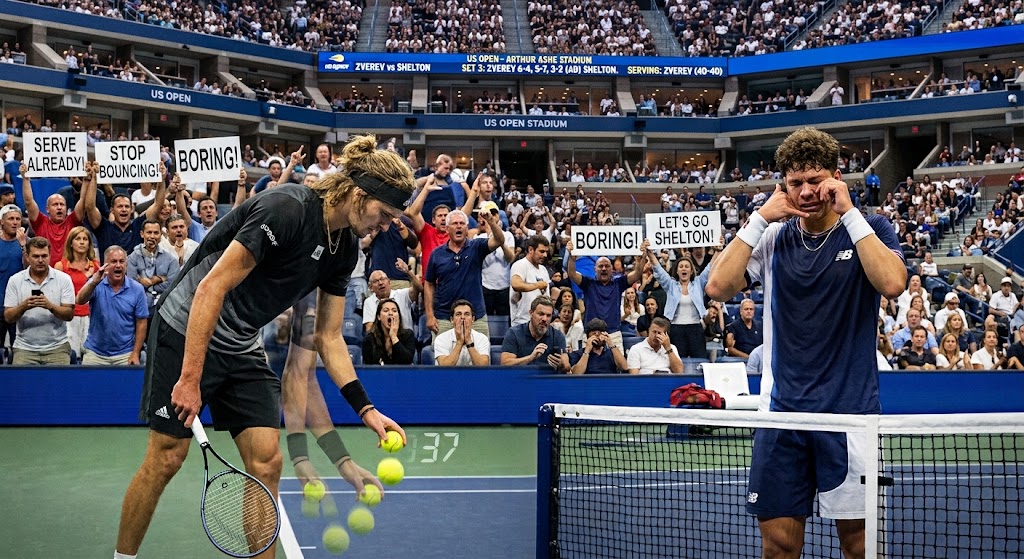
Have you ever watched Zverev play tennis? If you have, then you’ll know what I’m talking about. If you haven’t, then here’s all you need to know: It takes the dude forever to serve. For-ev-er. Seriously, he bounces the ball 13, 14, 15 times before every serve. Every GD time. Over and over. He pushes the serve clock to the brink every time. Every GD time.
Players are supposed to get 25 seconds from the end of the previous point to start their service motion. Zverev takes 24.98 seconds. Nah, check that – he probably takes more than 25 seconds, but the chair umpire lets him get away with it.
This is excruciating to watch. It’s not just me who thinks this, either. Google “why does Zverev take so long to serve” and you get nearly 32 million results, including links to this and this and this and this and this and on and on and on.
It takes me about one game of watching Zverev go through his ball-bouncing routine before I change the channel. I can’t watch it. Won’t watch it. It kills the enjoyment; sucks the life out of the whole affair. It gets in my head and stays there and makes me want to smash things.
He’s not the only offender, either. Novak Djokovic has been doing the same thing for two decades. I can’t watch him play, either, and will not mourn his imminent retirement the same way I mourned the retirements of fellow Big Three tennis legends Roger Federer and Rafael Nadal.
Croatia’s Maran Cilic does the same thing – bouncing, bouncing, bouncing – and I cannot wait for him to finally hang up his racket and move the hell along.
I feel the same way about Sasha Zverev, so I didn’t watch him whip Big Ben’s ass in the U.S. Open men’s final. I don’t know if that’s a sad commentary on me or tennis or Sasha or all of the above.
What I do know is that as much as I think I love tennis, I have limits on what I will endure as a fan. Which mainly means that I don’t love it as much as I think I do. It’s not unconditional love, at any rate. It’s love with an asterisk.
I love playing tennis. But I don’t always love watching it. And really, playing it is more important than watching it. This could apply to any element of life, when you think about it.
Being an active participant in the arena is always better than being a passive spectator. On your deathbed, you might not remember the stuff other people did. But you will remember the stuff you did. I consider that a positive thing.
And you know another positive thing?
I didn’t have to see another American man get taken down in a major tennis championship.
Again.
Image: Sasha bouncing the ball interminably, Ben crying while doing the “hang up the phone” gesture, and fans angry at it all.
 Vance Cariaga